Human Eye MCQs in English Part – 1 | Top 20 Important Questions
by
For aspirants preparing for competitive exams (RRB, SSC, TSPSC, APPSC, Police), the “Human Eye” topic from the General Science (Biology) section is highly crucial. Here, we have provided the best Human Eye MCQs in English based on Previous Year Questions (PYQs). In this post, we have covered important bits related to the Eye Structure and other Sensory Organs with detailed explanations. Check your preparation level right now!
Human Eye MCQs in English – Important Questions
Table of Contents
Basics
1. What is the number of sensory organs in the human body?
A) 3
B) 4
C) 5
D) 6
Answer
✅ Answer: C) 5
Explanation
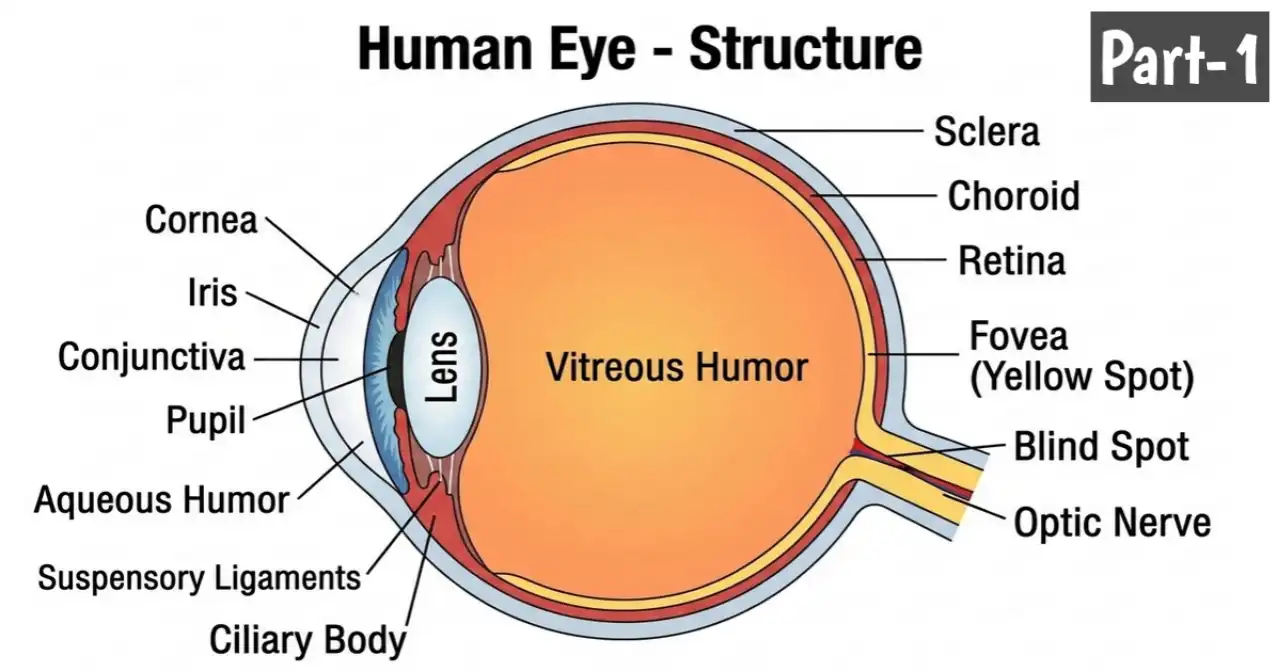
Explanation: There are five sensory organs in the human body. They are: eyes (sight), ears (hearing), nose (smell), tongue (taste), and skin (touch).
🗓️ Previous Year Question (PYQ):
☛ 2014 – RRB Group D
2. What is the study of the eye and its diseases called?
A) Dermatology
B) Ophthalmology
C) Cardiology
D) Osteology
Answer
✅ Answer: B) Ophthalmology
Explanation
Explanation: The study of the eye and its diseases is called ‘Ophthalmology’.
🗓️ Previous Year Question (PYQ):
☛ 2014 – SSC CGL☛ 2016 – RRB NTPC
1. Structure of the Eye
3. What is the outermost tough layer among the three main layers of the eye?
A) Retina
B) Choroid
C) Sclera
D) Iris
Answer
✅ Answer: C) Sclera
Explanation
Explanation: The outermost white tough layer that protects the eye is called the ‘Sclera’.
🗓️ Previous Year Question (PYQ):
☛ 2017 – SSC MTS
4. How many muscles in total help in the movement of the human eye?
A) 4
B) 6
C) 8
D) 10
Answer
✅ Answer: B) 6
Explanation
Explanation: A total of 6 muscles help move the eyeball in different directions (4 rectus and 2 oblique muscles).
🗓️ Previous Year Question (PYQ):
☛ 2016 – RRB NTPC☛ 2021 – SSC CHSL
5. Which middle layer contains blood vessels and provides nutrients and oxygen to the eye?
A) Sclera
B) Choroid
C) Retina
D) Cornea
Answer
✅ Answer: B) Choroid
Explanation
Explanation: The choroid is the middle layer of the eye. It is highly vascular and rich in blood vessels.
🗓️ Previous Year Question (PYQ):
☛ 2019 – APPSC Panchayat Secretary
2. Parts of the Eye
6. In eye donation, which part of the eye is exclusively harvested and donated from the donor?
A) Lens
B) Retina
C) Iris
D) Cornea
Answer
✅ Answer: D) Cornea
Explanation
Explanation: The entire eye is not removed during eye donation. Only the transparent front layer called the ‘Cornea’ is harvested and transplanted.
🗓️ Previous Year Question (PYQ):
☛ 2012 – APPSC Group 2☛ 2017 – SSC CGL
7. What is the small chamber located in the front part of the eye (between the cornea and the lens) called?
A) Vitreous chamber
B) Aqueous chamber
C) Retina
D) Yellow spot / Macula
Answer
✅ Answer: B) Aqueous chamber
Explanation
Explanation: The space between the cornea and the lens is called the aqueous chamber. It contains a watery fluid called ‘Aqueous humor’.
🗓️ Previous Year Question (PYQ):
☛ 2020 – SSC CPO
8. Which part of the eye is known as the ‘Window of the eye’?
A) Iris
B) Cornea
C) Sclera
D) Lens
Answer
✅ Answer: B) Cornea
Explanation
Explanation: The cornea is highly transparent. Since light first enters the eye through it, it is called the window of the eye.
🗓️ Previous Year Question (PYQ):
☛ 2019 – RRB JE
3. Iris and Pupil
9. Which is the main part that gives color (black, brown, or blue) to the eye?
A) Cornea
B) Iris
C) Retina
D) Optic Nerve
Answer
✅ Answer: B) Iris
Explanation
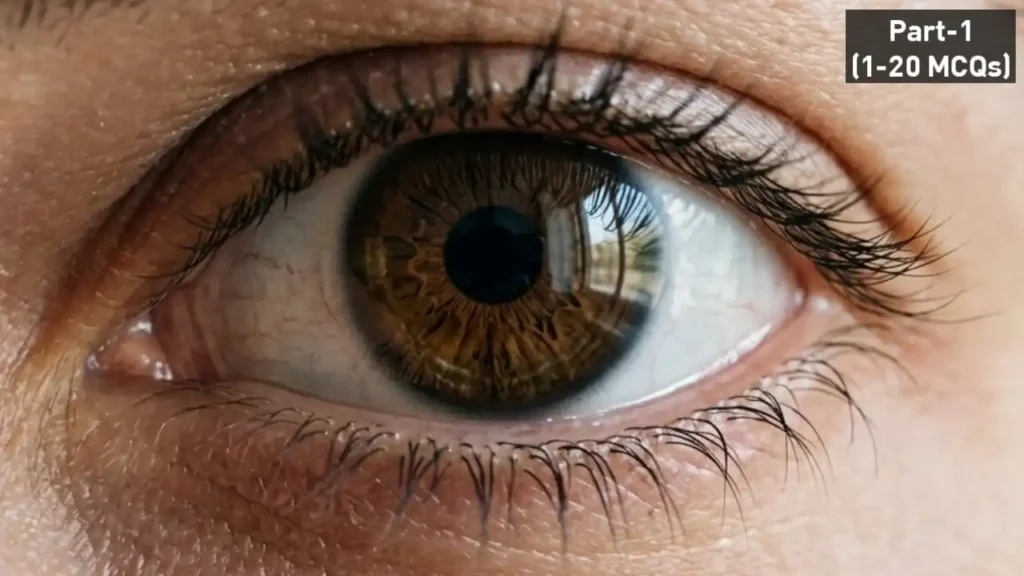
Explanation: The color of the eye depends on the melanin pigment present in the Iris.
🗓️ Previous Year Question (PYQ):
☛ 2018 – RRB ALP
10. Which part of the eye controls the intensity of light entering the eye?
A) Iris
B) Optic Nerve
C) Retina
D) Lens
Answer
✅ Answer: A) Iris
Explanation
Explanation: When there is excessive light, the Iris expands to reduce the amount of light entering.
🗓️ Previous Year Question (PYQ):
☛ 2016 – RRB NTPC
11. Which part of the eye works similarly to the ‘Diaphragm’ in a camera?
A) Lens
B) Cornea
C) Iris
D) Sclera
Answer
✅ Answer: C) Iris
Explanation
Explanation: Just as the diaphragm controls light in a camera, the Iris does the same in the human eye.
🗓️ Previous Year Question (PYQ):
☛ 2018 – SSC CHSL
12. Light enters the inner eye through a small hole in the center of the Iris. What is this hole called?
A) Pupil
B) Lens
C) Cornea
D) Blind spot
Answer
✅ Answer: A) Pupil
Explanation
Explanation: The dark-appearing hole in the center of the Iris is called the Pupil.
🗓️ Previous Year Question (PYQ):
☛ 2018 – AP Police Constable
13. What happens to the size of the Pupil in bright light or sunlight?
A) Dilates (becomes larger)
B) Constricts (becomes smaller)
C) No change
D) Closes
Answer
✅ Answer: B) Constricts (becomes smaller)
Explanation
Explanation: To prevent damage to the eye when we step into bright sunlight, the Iris expands and makes the Pupil opening very small.
🗓️ Previous Year Question (PYQ):
☛ 2018 – RRB ALP
14. How does the Pupil adjust to see objects clearly in dim light or darkness?
A) Constricts (becomes smaller)
B) Dilates (becomes larger)
C) Moves
D) Changes color
Answer
✅ Answer: B) Dilates (becomes larger)
Explanation
Explanation: When entering a dark room, more light is needed to see objects, so the size of the Pupil increases.
🗓️ Previous Year Question (PYQ):
☛ 2020 – SSC CHSL
4. Lens and Ciliary Muscles
15. Which part is located exactly behind the Iris in the eye?
A) Lens
B) Retina
C) Cornea
D) Blind spot
Answer
✅ Answer: A) Lens
Explanation
Explanation: After passing through the Iris and Pupil, light travels straight through the eye’s Lens.
16. The natural lens in the human eye acts like which type of lens?
A) Concave lens
B) Biconvex lens
C) Plano-convex lens
D) Cylindrical lens
Answer
✅ Answer: B) Biconvex lens
Explanation
Explanation: The lens in the human eye bulges outwards on both sides and acts as a Biconvex lens.
🗓️ Previous Year Question (PYQ):
☛ 2015 – SSC CGL
17. Which muscles help change the shape of the eye lens and adjust its focal length when looking at near or distant objects?
A) Iris muscles
B) Ciliary Muscles
C) Corneal muscles
D) Optic muscles
Answer
✅ Answer: B) Ciliary Muscles
Explanation
Explanation: The ciliary muscles that hold the lens change its focal length, allowing us to see near and distant objects clearly (Accommodation).
🗓️ Previous Year Question (PYQ):
☛ 2018 – TSPSC VRO
18. Where is the jelly-like fluid ‘Vitreous Humor’, which gives a specific shape to the eye, located?
A) Between cornea and lens
B) Between lens and retina
C) Between iris and cornea
D) Behind optic nerve
Answer
✅ Answer: B) Between lens and retina
Explanation
Explanation: ‘Vitreous Humor’ is present in the large chamber between the Lens and the Retina.
🗓️ Previous Year Question (PYQ):
☛ 2018 – RRB Group D
5. Retina
19. After light rays enter the eye, where is the image of the object formed?
A) Cornea
B) Lens
C) Retina
D) Iris
Answer
✅ Answer: C) Retina
Explanation
Explanation: Light refracts through the lens and focuses on the Retina at the back of the eye to form an image.
🗓️ Previous Year Question (PYQ):
☛ 2018 – RRB Group D☛ 2019 – SSC CHSL
20. Which part of the eye works similarly to the ‘Film’ in a camera?
A) Lens
B) Iris
C) Retina
D) Sclera
Answer
✅ Answer: C) Retina
Explanation
Explanation: Just as film is used to capture pictures in an older camera, the Retina acts as a screen to form images of objects in the eye.
🗓️ Previous Year Question (PYQ):
☛ 2019 – SSC MTS
We hope these top 20 Human Eye MCQs in English will be very helpful for your preparation. To easily answer questions from the Science section in the upcoming RRB, SSC, and Police exams, practice these Human Eye MCQs in English repeatedly. Please share this Human Eye MCQs in English article with your fellow aspirants. For more General Science bits, follow our website.