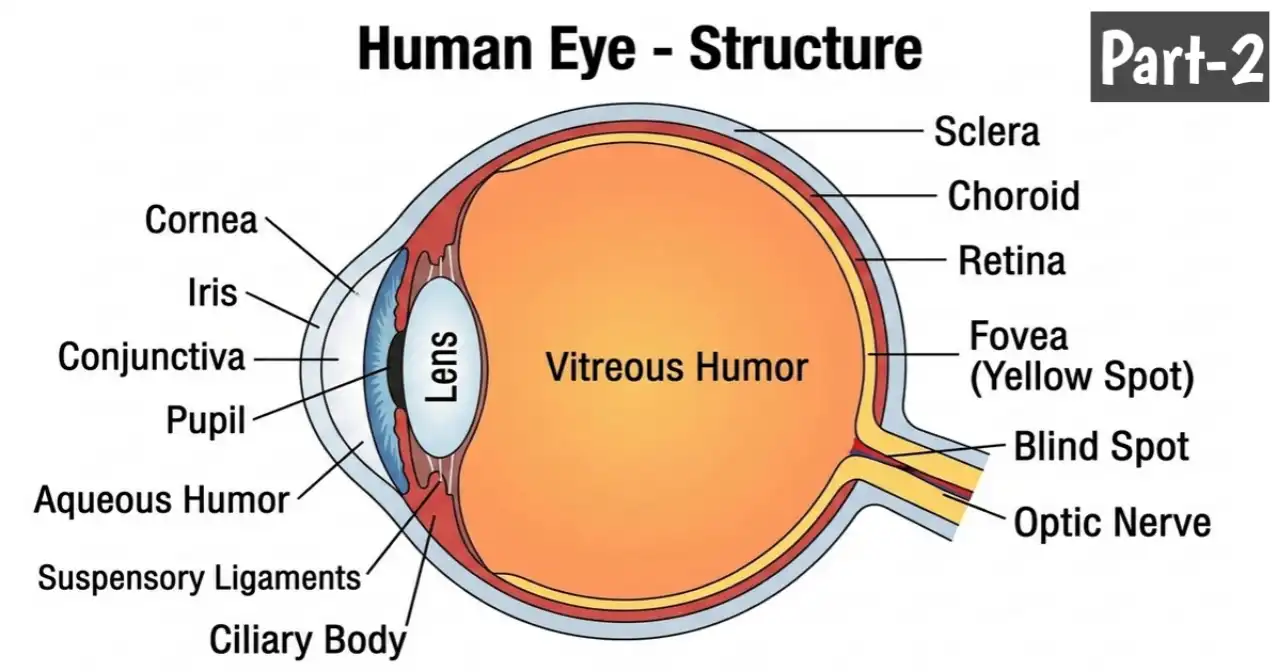
For candidates preparing for competitive exams (RRB, SSC, TSPSC, APPSC), the “Human Eye” topic from the General Science section is highly crucial. Here, we have provided the best Human Eye Objective Questions for practice. Check your preparation level right now with these detailed explanations.
Human Eye Objective Questions – Practice MCQs
Table of Contents
5. Retina – Continued
21. What is the nature of the image formed on the retina of the human eye?
Answer
✅ Answer: B) Real and Inverted
Explanation
Explanation: The image formed by the eye lens on the retina is always real and inverted. The brain (via the optic nerve) processes it and interprets it as erect (upright).
🗓️ Previous Year Question:
☛ 2016 – SSC CGL
☛ 2018 – TSPSC Group 4
22. What is the central point on the retina where the image is formed most clearly and sharply?
Answer
✅ Answer: C) Macula / Fovea
Explanation
Explanation: The small pit-like area in the center of the retina is called the Yellow Spot (Macula or Fovea). It has the highest concentration of cone cells, resulting in the sharpest and clearest image formation.
🗓️ Previous Year Question:
☛ 2017 – UPSC CDS
23. Which part of the retina has no rods or cones, and if an image is formed here, we cannot see it?
Answer
✅ Answer: A) Blind spot
Explanation
Explanation: At the point where the optic nerve leaves the eye and travels to the brain, there are no light-sensitive rods or cones. This area is called the Blind Spot. If an image falls here, the object remains invisible to us.
🗓️ Previous Year Question:
☛ 2017 – APPSC Panchayat Secretary
6. Photoreceptors (Rods and Cones)
24. How many main types of light-sensitive cells (photoreceptors) are present in the human eye?
Answer
✅ Answer: B) 2 Types (Rods and Cones)
Explanation
Explanation: The retina in the human eye mainly contains two types of photoreceptor cells responsible for capturing light: Rods and Cones.
25. What is the approximate ratio of rod cells to cone cells in the human eye?
Answer
✅ Answer: B) 15:1
Explanation
Explanation: Rod cells are much more numerous in the human eye. Their ratio to cone cells is approximately 15:1. There are about 120 million rods and only around 7 million cones.
🗓️ Previous Year Question:
☛ 2019 – APPSC Group 2
26. Which cells in the eye help us to see objects in the dark or in dim light (Night vision)?
Answer
✅ Answer: B) Rods
Explanation
Explanation: Rod cells contain a pigment called rhodopsin, which helps us see objects in dim light or darkness (in black and white, or grayscale).
🗓️ Previous Year Question:
☛ 2019 – APPSC Group 2
27. Which cells are responsible for identifying colors in daylight or bright light (Color vision)?
Answer
✅ Answer: A) Cones
Explanation
Explanation: Cone cells contain a pigment called iodopsin, which functions in bright light and is responsible for color vision and high visual acuity.
🗓️ Previous Year Question:
☛ 2018 – SSC CGL
☛ 2022 – RRB Group D
28. Which primary colors do the cone cells in the human eye primarily detect?
Answer
✅ Answer: B) Red, Green, Blue (RGB)
Explanation
Explanation: The cone cells in the human eye primarily detect three primary colors: Red, Green, and Blue (RGB). The combination of these three allows us to see millions of other colors.
🗓️ Previous Year Question:
☛ 2016 – RRB NTPC
☛ 2021 – SSC CGL
29. Which set of primary colors is often referred to as “Television Colors” in relation to the eye?
Answer
✅ Answer: C) Red, Green, Blue (RGB)
Explanation
Explanation: Red, Green, and Blue (RGB) are known as primary colors or television colors. TV and mobile screens use the combination of these three basic colors to produce all other visible colors.
🗓️ Previous Year Question:
☛ 2017 – SSC CHSL
7. Optic Nerve
30. Which nerve connects the retina to the brain and transmits visual information?
Answer
✅ Answer: B) Optic Nerve
Explanation
Explanation: Information about the image formed on the retina is transmitted to the brain in the form of electrical signals via the Optic Nerve.
🗓️ Previous Year Question:
☛ 2016 – TSPSC Police Constable
31. Which part of the brain analyzes the visual signals sent by the optic nerve and interprets the image?
Answer
✅ Answer: C) Occipital lobe (Visual cortex)
Explanation
Explanation: The Occipital Lobe, located at the back of the brain (also known as the visual cortex), processes the signals received from the optic nerve, allowing us to understand and recognize objects and colors.
🗓️ Previous Year Question:
☛ 2019 – SSC CPO
☛ 2022 – TSPSC Group 1
8. Mechanism of Vision
32. Where does the maximum refraction of light rays occur when they enter the eye?
Answer
✅ Answer: A) Cornea
Explanation
Explanation: Most of the refraction (bending) of light rays entering the eye from the air occurs at the outer, curved surface of the Cornea. The lens then fine-tunes the focus.
🗓️ Previous Year Question:
☛ 2018 – RRB ALP
33. What is the persistence of vision for a normal human eye (the time an image remains on the retina)?
Answer
✅ Answer: C) 0.1 Second (1/16th of a second)
Explanation
Explanation: The impression of an image stays on the retina for about 1/16th of a second (0.1 second) even after the object is removed. This phenomenon is known as the persistence of vision.
🗓️ Previous Year Question:
☛ 2015 – SSC CGL
☛ 2020 – RRB NTPC
34. What type of vision allows humans and monkeys to see a single clear object using both eyes together?
Answer
✅ Answer: C) Binocular vision
Explanation
Explanation: In humans and monkeys, both eyes are positioned at the front of the head, allowing them to focus on a single object simultaneously. This is called ‘Binocular Vision’, which provides accurate depth perception (3D vision).
35. What is the type of vision formed by the compound eyes found in insects?
Answer
✅ Answer: B) Mosaic vision
Explanation
Explanation: Insects (like flies and cockroaches) have compound eyes made up of thousands of individual visual units called ommatidia. The resulting image is formed in multiple pieces, which is known as ‘Mosaic Vision’.
🗓️ Previous Year Question:
☛ 2018 – SSC CHSL
36. What is the type of vision in animals like fish, amphibians, and rabbits, where the eyes are on either side of the head, allowing them to see two different objects simultaneously?
Answer
✅ Answer: D) Monocular vision
Explanation
Explanation: Animals with eyes on the sides of their heads (like fish and rabbits) process two separate fields of view independently. This is called Monocular Vision, providing them with a wider field of view to detect predators.
🗓️ Previous Year Question:
☛ 2016 – TSPSC Police Constable
37. What is the maximum number of distinct images a human can clearly process in one minute?
Answer
✅ Answer: C) Less than 16 per second (approx. 960/min)
Explanation
Explanation: Due to the persistence of vision (1/16th of a second), a human eye can process fewer than 16 separate images per second. If images flash faster than this, they appear as continuous motion (like in movies).
9. Accommodation of Eye
38. What is the least distance of distinct vision for a healthy human eye?
Answer
✅ Answer: B) 25 cm
Explanation
Explanation: The minimum distance at which an object can be seen clearly without any strain to the eyes is called the least distance of distinct vision. For a healthy young adult, this distance is precisely 25 cm.
🗓️ Previous Year Question:
☛ 2014 – SSC CGL
☛ 2018 – RRB Group D
☛ 2022 – APPSC Group 4
39. What is the recommended minimum distance to maintain between the eye and a book while reading?
Answer
✅ Answer: D) 30 cm
Explanation
Explanation: To prevent strain on the eye muscles, it is highly recommended to maintain a minimum distance of about 30 cm (approx. one foot) between the book and your eyes while reading.
10. Defects of Vision
40. What is the vision defect called when the image is formed in front of the retina instead of on it?
Answer
✅ Answer: D) Myopia (Nearsightedness)
Explanation
Explanation: If the image of a distant object is formed in front of the retina (before reaching it), the defect is called Myopia or Nearsightedness. A person with this defect can only see nearby objects clearly.
🗓️ Previous Year Question:
☛ 2016 – RRB NTPC
☛ 2021 – SSC GD
We hope these top 20 Human Eye Objective Questions (Part 2) will be very helpful for your preparation. Practice these questions repeatedly to easily answer Science bits in the upcoming RRB, SSC, and Police exams. For more General Science practice tests, follow our website.