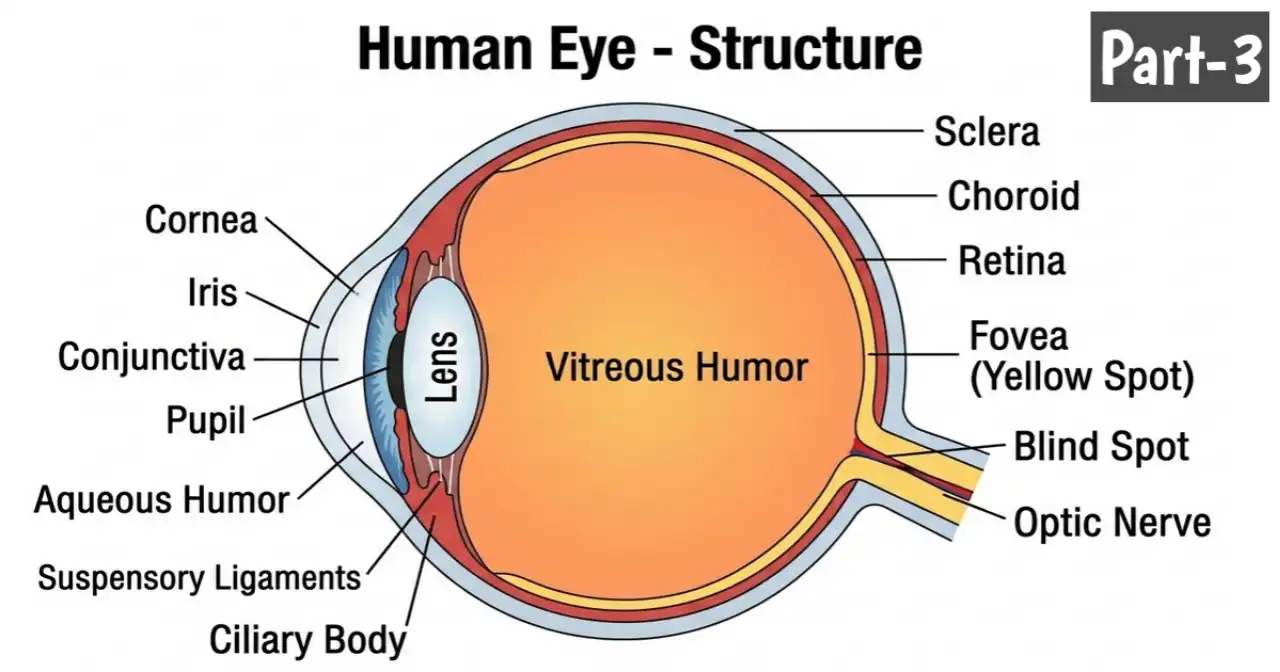
In the General Science section, sensory organs like the Human eye play a vital role in competitive exams. In this post, we have compiled the most frequently asked Human Eye Questions and Answers based on Previous Year Questions (PYQs). Practicing these top Human Eye Questions and Answers is highly crucial for RRB, SSC, and state-level exams.
Human Eye Questions and Answers – Practice Bits
Table of Contents
10. Defects of Vision – Continued
41. Which lens is used to correct ‘Myopia’ (Nearsightedness), a defect where a person can see near objects clearly but not distant objects?
Answer
✅ Answer: B) Concave Lens
Explanation
Explanation: In Myopia, the image is formed in front of the retina. Using a concave lens diverges the light rays, causing the image to be formed exactly on the retina.
🗓️ Previous Year Question:
☛ 2018 – TSPSC VRO
☛ 2021 – RRB NTPC
42. How does a concave lens act on light rays to ensure the image falls exactly on the retina for a person with Myopia?
Answer
✅ Answer: B) Diverges
Explanation
Explanation: A concave lens diverges the incoming light rays before they reach the eye lens. This allows the natural convex lens of the eye to focus the rays correctly on the retina.
🗓️ Previous Year Question:
☛ 2017 – SSC CGL
43. Which lens is used to correct ‘Hypermetropia’ (Farsightedness), where a person can see distant objects clearly but not near objects?
Answer
✅ Answer: B) Convex Lens
Explanation
Explanation: In Hypermetropia, the image is formed behind the retina. A convex lens converges the light rays earlier, ensuring the image is focused directly on the retina.
🗓️ Previous Year Question:
☛ 2019 – APPSC Panchayat Secretary
☛ 2020 – SSC CGL
44. Which lens is used to correct ‘Presbyopia’, a defect arising due to the weakening of eye muscles with aging?
Answer
✅ Answer: C) Bifocal Lens
Explanation
Explanation: In older age, due to the weakening of ciliary muscles, people may suffer from both nearsightedness and farsightedness (Presbyopia). This is corrected using bifocal lenses (concave on top, convex on bottom).
🗓️ Previous Year Question:
☛ 2019 – RRB JE
☛ 2021 – SSC MTS
45. Which lens is used to correct ‘Astigmatism’, a defect caused by the irregular curvature of the eye lens or cornea?
Answer
✅ Answer: B) Cylindrical lens
Explanation
Explanation: Astigmatism causes blurred vision due to uneven curvature of the cornea or lens. It is corrected accurately by using a cylindrical lens.
🗓️ Previous Year Question:
☛ 2018 – SSC CHSL
11. Eye Diseases
46. Which disease is caused by the deficiency of rod cells in the eye or a lack of Vitamin ‘A’?
Answer
✅ Answer: D) Night Blindness
Explanation
Explanation: Deficiency of Vitamin A (Retinol) reduces the production of rhodopsin in rod cells, leading to poor vision in dim light or darkness, known as Night Blindness (Nyctalopia).
🗓️ Previous Year Question:
☛ 2018 – RRB Group D
☛ 2021 – SSC GD
47. Which eye disease is caused by a defect in the cone cells that are responsible for daytime color vision?
Answer
✅ Answer: A) Color Blindness
Explanation
Explanation: A defect or absence of cone cells in the retina leads to an inability to distinguish certain colors. This condition is known as Color Blindness.
🗓️ Previous Year Question:
☛ 2018 – RRB Group D
48. People with color blindness primarily have difficulty distinguishing between which two colors?
Answer
✅ Answer: B) Red and Green
Explanation
Explanation: Red-green color blindness is the most common form of this genetic disorder. Affected individuals struggle to perceive the difference between red and green hues.
🗓️ Previous Year Question:
☛ 2018 – AP Police SI
☛ 2019 – SSC CGL
49. Which official test is used by doctors to diagnose ‘Color Blindness’?
Answer
✅ Answer: B) Ishihara test
Explanation
Explanation: To diagnose color blindness, doctors use plates containing dotted patterns of various colors (which hide numbers). This is widely known as the ‘Ishihara test’.
🗓️ Previous Year Question:
☛ 2019 – RRB NTPC
50. What type of disease is Color blindness?
Answer
✅ Answer: C) Hereditary / Genetic disease
Explanation
Explanation: Color blindness is not caused by any infection. It is a genetic disorder inherited from parents and passed down from one generation to the next.
51. Why is color blindness generally more common in men than in women?
Answer
✅ Answer: B) Because it is an X-chromosome linked genetic defect
Explanation
Explanation: Men (XY) have only one X chromosome, so if it carries the defective gene, they will have the disease. Women (XX) have two, so they usually act only as carriers unless both chromosomes are affected.
🗓️ Previous Year Question:
☛ 2016 – UPSC CDS
52. What is the disease called where the eye lens of an elderly person loses transparency and becomes cloudy?
Answer
✅ Answer: B) Cataracts
Explanation
Explanation: As people age, the eye lens can lose its transparency, becoming cloudy or white. This impairs vision and is commonly known as Cataracts.
🗓️ Previous Year Question:
☛ 2018 – TSPSC Group 4
53. What is the primary permanent treatment in modern medicine for elderly patients suffering from ‘Cataracts’?
Answer
✅ Answer: C) Surgical implantation of an artificial lens (IOL surgery)
Explanation
Explanation: During cataract surgery, the cloudy natural lens is removed and replaced with an artificial ‘Intraocular Lens’ (IOL), which restores clear vision permanently.
54. ‘Glaucoma’ (caused by increased fluid pressure damaging the optic nerve) and ‘Trachoma’ (blisters inside the eyelids) are diseases that affect which organ?
Answer
✅ Answer: C) Eye
Explanation
Explanation: Glaucoma is a condition where high intraocular pressure damages the optic nerve, leading to blindness. Trachoma is a bacterial eye infection causing rough inner eyelids. Both affect the eyes.
🗓️ Previous Year Question:
☛ 2017 – SSC CGL
☛ 2021 – RRB NTPC
55. What is the condition called when the thin inner layer of the eyelids (conjunctiva) gets infected by bacteria or viruses, causing swelling and red eyes?
Answer
✅ Answer: C) Conjunctivitis (Madras Eye / Pink Eye)
Explanation
Explanation: Inflammation or infection of the conjunctiva (the clear membrane covering the white part of the eye) is known as Conjunctivitis. It is commonly referred to as ‘Pink Eye’ or ‘Madras Eye’.
12. Eye Care
56. To maintain proper eye care and specifically prevent night blindness, foods rich in which vitamin should be consumed?
Answer
✅ Answer: D) Vitamin A (Retinol)
Explanation
Explanation: Vitamin A (found in carrots, leafy greens, papaya) is essential for improving vision, maintaining a healthy retina, and preventing night blindness.
🗓️ Previous Year Question:
☛ 2017 – APPSC Group 2
☛ 2021 – SSC MTS
57. Which glands are responsible for producing and secreting tears from the eyes?
Answer
✅ Answer: A) Lacrimal Glands
Explanation
Explanation: Lacrimal glands, located above the eyeball, produce tears. They help keep the eye moist and wash away dust and particles.
🗓️ Previous Year Question:
☛ 2016 – RRB NTPC
58. Which natural enzyme is present in tears to destroy bacteria and microbes entering the eye?
Answer
✅ Answer: B) Lysozyme
Explanation
Explanation: Tears contain an antibacterial enzyme called ‘Lysozyme’. It destroys harmful microbes and protects the eyes from various infections.
🗓️ Previous Year Question:
☛ 2018 – SSC CPO
☛ 2022 – TSPSC Group 4
59. Which gland is located under the eyelids and secretes an oily substance to prevent the eyeball from drying out?
Answer
✅ Answer: C) Meibomian Gland
Explanation
Explanation: Meibomian glands, situated at the edges of the eyelids, secrete an oily substance that prevents tears from evaporating quickly, keeping the eye moisturized.
🗓️ Previous Year Question:
☛ 2019 – SSC CGL
60. Which skin receptors primarily help blind people in reading the Braille script?
Answer
✅ Answer: C) Tactile receptors
Explanation
Explanation: Blind people read Braille script by touching the raised dots with their fingers. This is made possible by ‘Tactile receptors’ (touch receptors) present in the skin.
🗓️ Previous Year Question:
☛ 2018 – TS TET
We hope these Human Eye Questions and Answers (Part 3) have added great value to your exam preparation. Since we have covered all crucial PYQs, practice these Human Eye Questions and Answers well before your exams. Keep visiting our website for more General Science MCQs.