Welcome Candidates! The General Science section is highly important for candidates preparing for government jobs. Therefore, we provide topic-wise General Science MCQs and notes on our website.
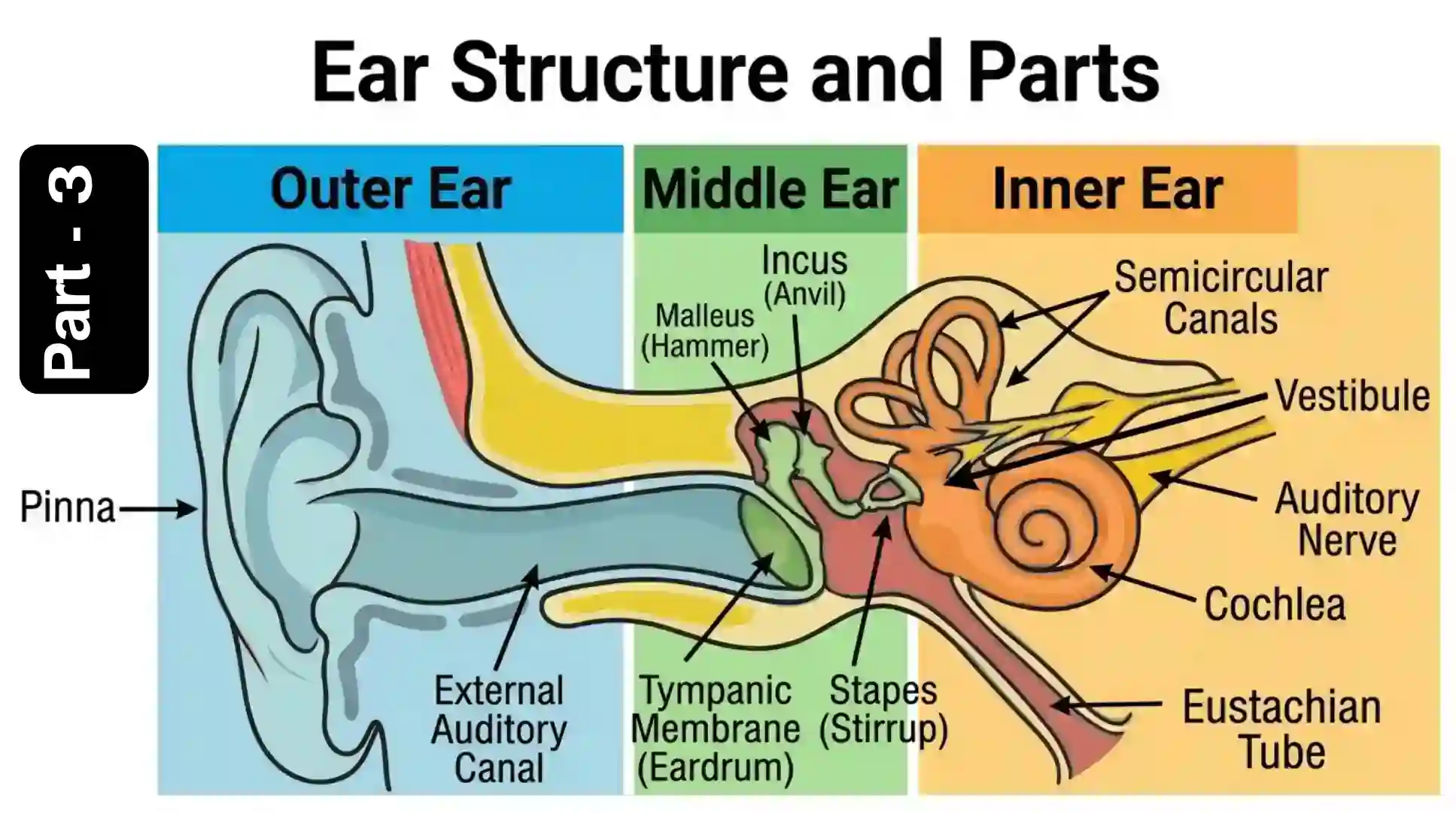
Continuing from the previous part, in this post, through [ Structure of Human Ear Part 3 ], we will practice important questions frequently asked in competitive exams related to the topic ❛Sense Organs: Structure and Parts of the Human Ear❜. These questions are highly useful for UPSC, SSC, RRB, POLICE, and all state-level competitive exams. So without any delay, let’s start the practice!
Table of Contents
Inner Ear and Cochlea | Structure of Human Ear Part 3
4. Inner Ear & Cochlea
41. Which part of the ear is directly connected to the brain?
A) Eardrum
B) Eustachian tube
C) Cochlear nerves / Inner ear
D) Pinna
Answer
✅ Answer: C) Cochlear nerves / Inner ear
Explanation
Explanation: The cochlear nerves located in the inner ear receive sound signals and are directly connected to the brain.
42. Through which path do sound waves enter the cochlea?
A) Round window
B) Oval window / Fenestra Ovalis
C) Eardrum
D) Auditory canal
Answer
✅ Answer: B) Oval window / Fenestra Ovalis
Explanation
Explanation: The stapes bone of the middle ear is attached to the oval window, which transmits sound vibrations into the cochlea.
43. What are the fluid-filled pathways in the cochlea called?
A) Scala Vestibuli and Scala Tympani
B) Eustachian tubes
C) Semicircular canals
D) Endolymphatic ducts
Answer
✅ Answer: A) Scala Vestibuli and Scala Tympani
Explanation
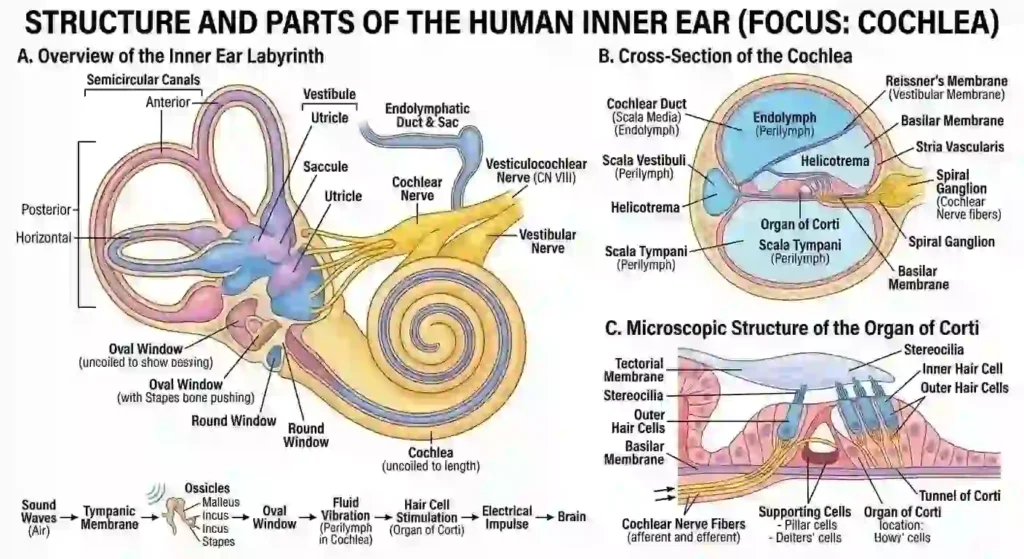
Explanation: There are mainly three chambers for fluid to flow inside the cochlea. Among them, Scala Vestibuli and Scala Tympani are the major pathways.
44. What is the ‘inner ear’, the main center of human hearing, called?
A) Labyrinth
B) Cochlea
C) Auricle
D) Tympanum
Answer
✅ Answer: A) Labyrinth
Explanation
Explanation: The inner ear is composed of a very complex structure of ducts and tubes, hence it is called the Labyrinth.
45. How long does the effect of a sound remain in the brain after hearing it (Persistence of hearing)?
A) 1 second
B) 0.5 seconds
C) 0.1 seconds (1/10th of a second)
D) 0.01 seconds
Answer
✅ Answer: C) 0.1 seconds (1/10th of a second)
Explanation
Explanation: The human brain retains the effect of a sound for 1/10th of a second after hearing it. This is called the persistence of hearing.
46. What should be the minimum distance between the sound source and the reflecting surface to hear a clear echo?
A) 10 meters
B) 17.2 meters
C) 25 meters
D) 34 meters
Answer
✅ Answer: B) 17.2 meters
Explanation
Explanation: To hear an echo, it must take at least 0.1 seconds for the sound to travel and return. Based on the speed of sound in the air, this minimum distance must be 17.2 meters.
▫️ Semicircular Canals & Vestibule
47. How many semi-circular canals are there in the ear?
A) 2
B) 3
C) 4
D) 5
Answer
✅ Answer: B) 3
Explanation
Explanation: There are 3 semicircular canals in the inner ear. These help in maintaining the balance of the body.
48. Which parts of the ear maintain body balance by detecting the position of the head in static equilibrium?
A) Cochlea and Organ of Corti
B) Malleus and Incus
C) Utricle and Saccule
D) Auditory canal and Eardrum
Answer
✅ Answer: C) Utricle and Saccule
Explanation
Explanation: The utricle and saccule located in the vestibule of the inner ear maintain static equilibrium.
49. What are the calcium carbonate crystals found in the utricle and saccule called?
A) Nephroliths
B) Otoliths
C) Osteoblasts
D) Chondrocytes
Answer
✅ Answer: B) Otoliths
Explanation
Explanation: These otoliths move according to the movements of the head and help in detecting the position of the head based on gravitational force.
50. Which are the main structures of the ear that maintain body balance?
A) Eardrum and Ear ossicles
B) Semicircular canals and Vestibule
C) Cochlea and Organ of Corti
D) Pinna and Auditory canal
Answer
✅ Answer: B) Semicircular canals and Vestibule
Explanation
Explanation: The vestibular apparatus (semicircular canals and vestibule) located in the inner ear are the important parts that control the balance of the body.
51. Which part detects the balance of the body in a state of motion (Dynamic equilibrium)?
A) Semicircular canals
B) Utricle
C) Saccule
D) Cochlea
Answer
✅ Answer: A) Semicircular canals
Explanation
Explanation: When we walk or move, the fluid in these 3 semicircular canals moves and maintains dynamic equilibrium.
5. Mechanism of Hearing
52. Which of the cranial nerves that help in hearing is the auditory nerve?
A) 5th Cranial nerve
B) 7th Cranial nerve
C) 8th Cranial Nerve
D) 10th Cranial nerve
Answer
✅ Answer: C) 8th Cranial Nerve
Explanation
Explanation: Among the cranial nerves emerging from the brain, the 8th nerve, the Vestibulocochlear nerve, is called the auditory nerve. It helps in hearing.
53. Which nerve carries electrical signals from the ear to the brain?
A) Optic nerve
B) Olfactory nerve
C) Motor nerve
D) Auditory nerve
Answer
✅ Answer: D) Auditory nerve
Explanation
Explanation: The auditory nerve originating from the organ of Corti carries sound signals to the brain. This is how we are able to hear.
54. To which center of the brain do the signals of the auditory nerve reach?
A) Medulla oblongata and Temporal lobe
B) Frontal lobe
C) Parietal lobe
D) Cerebellum
Answer
✅ Answer: A) Medulla oblongata and Temporal lobe
Explanation
Explanation: Electrical signals carried by the auditory nerve pass through the medulla oblongata in the brainstem, and eventually reach the temporal lobe of the cerebrum.
55. Which part of the ear converts mechanical vibrations into electrical signals?
A) Eardrum
B) Hair cells in Organ of Corti
C) Malleus
D) Eustachian tube
Answer
✅ Answer: B) Hair cells in Organ of Corti
Explanation
Explanation: Microscopic hair cells in the ‘Organ of Corti’ in the inner ear vibrate due to sound waves and generate electrical nerve signals.
6. Balance Maintenance
56. Which part of the ear is also called the ‘Balancing Organ’?
A) Cochlea
B) Vestibular Apparatus
C) Pinna
D) Eardrum
Answer
✅ Answer: B) Vestibular Apparatus
Explanation
Explanation: The part consisting of the semicircular canals and the vestibule is called the vestibular apparatus. It plays a key role in maintaining body balance.
7. Ear Disorders
▫️ Tinnitus
57. What is the condition called where one hears a constant ringing sound in the ears even when there is no external sound?
A) Vertigo
B) Glaucoma
C) Otitis Media
D) Tinnitus
Answer
✅ Answer: D) Tinnitus
Explanation
Explanation: People with tinnitus experience ringing or buzzing sounds in their ears. It is caused by exposure to loud noises or damage to the nerves of the ear.
▫️ Otitis
58. What is an infection (usually in young children) in the middle ear caused by bacteria or viruses called?
A) Otitis Media
B) Otitis Externa
C) Tinnitus
D) Deafness
Answer
✅ Answer: A) Otitis Media
Explanation
Explanation: When a cold or throat infection reaches the middle ear through the Eustachian tube, it causes ‘Otitis Media’. This leads to earache and fever.
59. What is the infection of the outer ear canal caused by water entering the ear, commonly seen in swimmers, called?
A) Tinnitus
B) Otitis Media
C) Otitis Externa
D) Presbycusis
Answer
✅ Answer: C) Otitis Externa
Explanation
Explanation: The infection caused by water accumulating in the ear canal and the growth of bacteria or fungi is called otitis externa or ‘swimmer’s ear’.
▫️ Deafness
60. What is the main cause of ‘Conductive hearing loss’, a type of deafness?
A) Damage to auditory nerve
B) Brain defect
C) Sound not entering due to ear ossicles or eardrum issues
D) Dried fluid in cochlea
Answer
✅ Answer: C) Sound not entering due to ear ossicles or eardrum issues
Explanation
Explanation: When sound waves do not transmit properly through the outer and middle ear to the inner ear, ‘conductive hearing loss’ occurs. This is caused by a ruptured eardrum or reduced movement of the ear bones.
Candidates! In this post, we have practiced important questions related to Structure of Human Ear Part 3. We hope these will be very useful for your upcoming competitive exams.
🔗 More Information: If you want to know more about the structure of the ear in detail, you can read on Wikipedia.
Note: If you find these questions useful, please share them with your friends. Also, if you have any doubts or want to give valuable suggestions, please let us know through our email [email protected].