Welcome Candidates! The General Science (Biology) section is highly important for those preparing for government jobs. Therefore, we are providing topic-wise General Science MCQs and notes on our website.
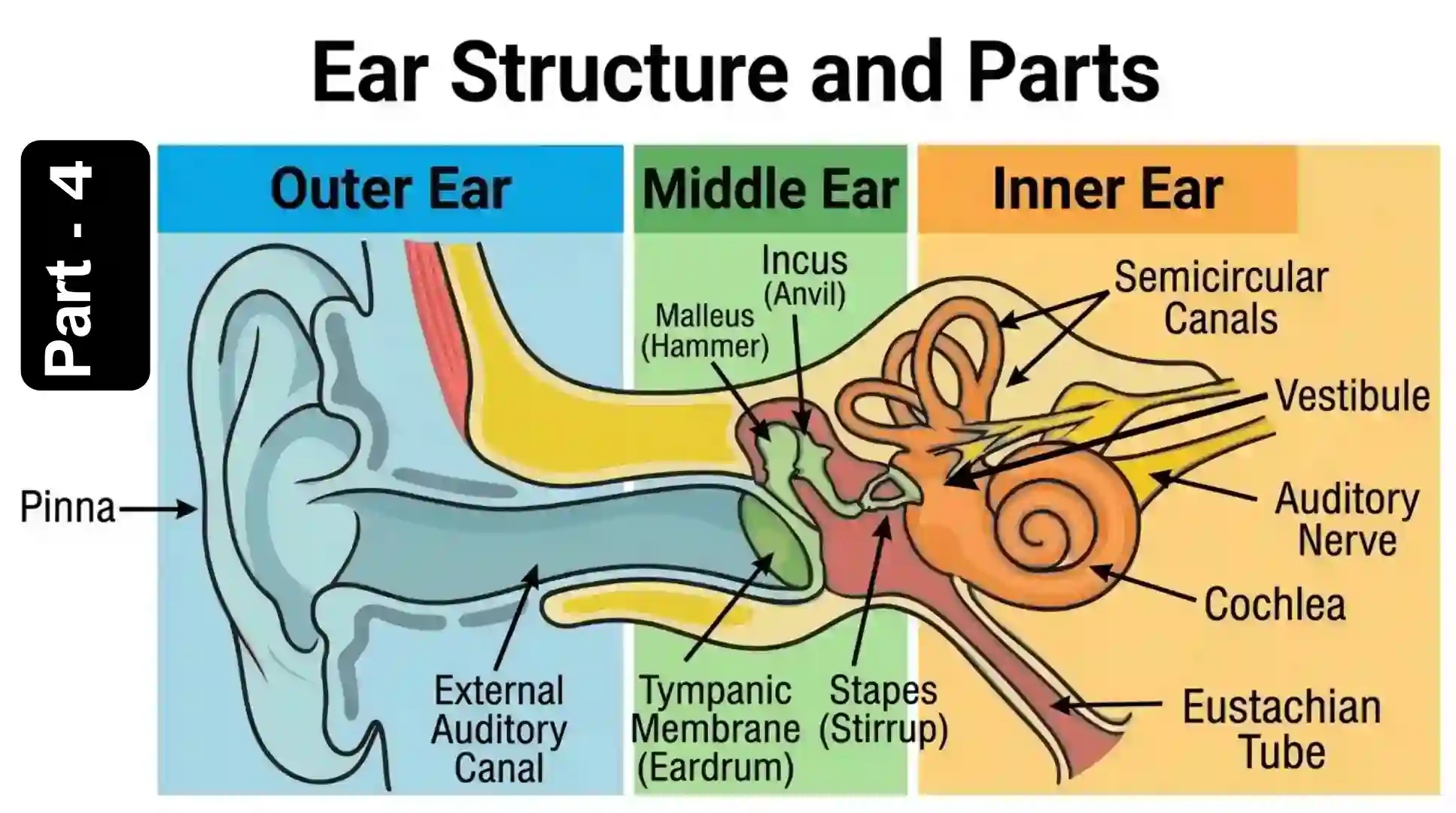
Continuing from the previous part, in this post, through [ Human Ear Anatomy Part 4 ], we will practice important questions frequently asked in previous exams from the topic ❛Sense Organs: Structure and Parts of the Human Ear❜. These will be very useful for UPSC, SSC, RRB, APPSC, TSPSC, and Police exams. So without any delay, let’s start the practice!
Table of Contents
Ear Disorders and Care | Human Ear Anatomy Part 4
7. Ear Disorders & Care
61. Which instrument is used to detect hearing loss?
A) Audiometer
B) Sphygmomanometer
C) Barometer
D) Altimeter
Answer
✅ Answer: A) Audiometer
Explanation
Explanation: An instrument called an audiometer is used to accurately measure a person’s hearing ability or hearing loss (deafness).
62. Which part does the ‘Cochlear Implant’ placed in people with hearing loss stimulate directly?
A) Eardrum
B) Ear ossicles
C) Cochlea
D) Auditory nerve
Answer
✅ Answer: D) Auditory nerve
Explanation
Explanation: Bypassing the damaged parts of the ear, this implant directly stimulates the auditory nerve with electrical signals and transmits the sound to the brain.
63. Which disease causes hearing loss due to abnormal growth of ear bones?
A) Otosclerosis
B) Otitis Media
C) Vertigo
D) Tinnitus
Answer
✅ Answer: A) Otosclerosis
Explanation
Explanation: Due to abnormal growth and hardening of the middle ear bones (especially stapes), sound vibrations cannot reach the inner ear. This disease is called otosclerosis.
64. Which part of the ear is the main cause of ‘Motion sickness’ (vomiting, dizziness during travel)?
A) Eardrum
B) Vestibular system
C) Cochlea
D) Auditory canal
Answer
✅ Answer: B) Vestibular system
Explanation
Explanation: When the eyes tell the brain that we are stationary, but the ear’s balancing organ tells us that we are moving, this imbalance causes motion sickness during travel.
65. What is the condition of dizziness caused by damage to the vestibular system called?
A) Tinnitus
B) Vertigo
C) Deafness
D) Amnesia
Answer
✅ Answer: B) Vertigo
Explanation
Explanation: The feeling that the surroundings are spinning in circles is called vertigo. It is mainly caused by the disturbance of vestibular balance in the inner ear.
66. What is age-related hearing loss called?
A) Presbyopia
B) Myopia
C) Presbycusis
D) Otosclerosis
Answer
✅ Answer: C) Presbycusis
Explanation
Explanation: Hearing loss due to the degeneration of nerve cells (hair cells) in the inner ear caused by old age is called presbycusis.
67. What is the condition called where one hears a constant ringing sound in the ears even when there is no external sound?
A) Otitis Externa
B) Glaucoma
C) Vertigo
D) Tinnitus
Answer
✅ Answer: D) Tinnitus
Explanation
Explanation: Tinnitus means experiencing a ringing or buzzing sound in the ear even when there is no external sound. It is caused by exposure to loud noise.
8. Care of Ear & Intensity of Sound
▫️ Care of Ear & Intensity of Sound
68. What are the medicines that reduce ear pain called?
A) Otic Analgesics
B) Optic Analgesics
C) Antibiotics
D) Dermatologicals
Answer
✅ Answer: A) Otic Analgesics
Explanation
Explanation: ‘Otic’ means related to the ear and ‘analgesics’ means painkillers. Drops that reduce ear pain are called otic analgesics.
69. What is an Ear, Nose, Throat (ENT) specialist called?
A) Ophthalmologist
B) Otolaryngologist
C) Oncologist
D) Cardiologist
Answer
✅ Answer: B) Otolaryngologist
Explanation
Explanation: ENT (Ear, Nose, Throat) doctors are called otolaryngologists in scientific terminology.
70. What is the unit for measuring the intensity of sound?
A) Hertz
B) Watts
C) Decibel (dB)
D) Joules
Answer
✅ Answer: C) Decibel (dB)
Explanation
Explanation: The volume or intensity of sound is measured in decibels (dB). Whereas the frequency of sound is measured in hertz (Hz).
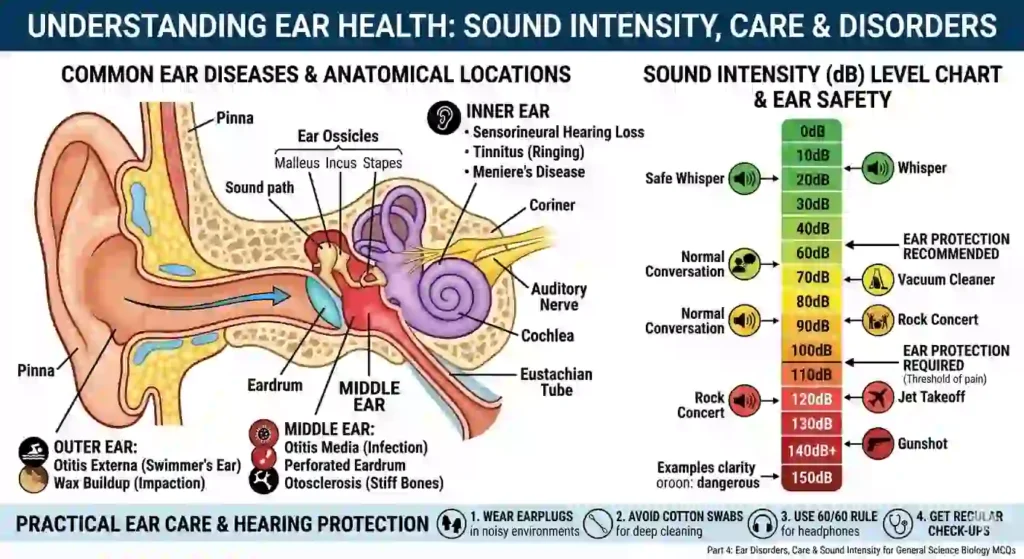
71. What is the approximate intensity of sound in normal conversation?
A) 10 – 20 dB
B) 80 – 100 dB
C) 40 – 60 dB
D) 120 – 140 dB
Answer
✅ Answer: C) 40 – 60 dB
Explanation
Explanation: Generally, the sound intensity during conversation between people is between 40 dB and 60 dB. It is safe for the ears.
72. What is the safe sound level for humans according to the World Health Organization (WHO)?
A) 80 dB
B) 45 dB – Safe
C) 100 dB
D) 20 dB
Answer
✅ Answer: B) 45 dB – Safe
Explanation
Explanation: According to the WHO, noise levels of 45 dB during the day and 35 dB at night are safe and do not cause stress in humans.
73. What is the maximum sound level in normal conversation?
A) 20 dB
B) 40 dB
C) 60 dB
D) 90 dB
Answer
✅ Answer: C) 60 dB
Explanation
Explanation: In a normal environment, conversation, TV sound, etc. are up to 60 dB. Prolonged exposure to levels above this can gradually lead to hearing problems.
74. What sound intensity level causes pain in the ear? (or) What is the sound level that damages the ear?
A) More than 60 dB
B) More than 120 dB
C) More than 80 dB
D) More than 40 dB
Answer
✅ Answer: B) More than 120 dB
Explanation
Explanation: Sound levels crossing 120 dB to 130 dB (e.g., sound of a jet plane taking off, DJ sound) cause severe pain in the ear and can damage the eardrum.
75. What is the audible range of humans? (or) What is the frequency of sound that can be heard by humans?
A) 200 Hz to 2,000 Hz
B) 20 Hz to 20,000 Hz
C) Above 20,000 Hz
D) 2 Hz to 20 Hz
Answer
✅ Answer: B) 20 Hz to 20,000 Hz
Explanation
Explanation: A healthy human can only hear sounds with frequencies from 20 hertz (Hz) to 20,000 hertz.
76. What are sounds with frequencies less than 20 Hz called?
A) Ultrasonics
B) Audible sounds
C) Infrasonics
D) Mach sounds
Answer
✅ Answer: C) Infrasonics
Explanation
Explanation: Sounds generated during an earthquake fall in this category. Elephants and whales can feel them, but humans cannot hear them.
77. What are sounds with frequencies above 20,000 Hz called?
A) Infrasonics
B) Ultrasonics
C) Sonic boom
D) Supersonics
Answer
✅ Answer: B) Ultrasonics
Explanation
Explanation: Sounds above 20,000 Hz are called ultrasonic sounds. They are used in the medical field for scanning (Ultrasonography) and measuring the depth of the ocean.
78. What sounds can dogs and bats hear?
A) Infrasonics
B) Audible sounds
C) Ultrasonics
D) All of the above
Answer
✅ Answer: C) Ultrasonics
Explanation
Explanation: Bats and dolphins produce ultrasonic sounds and catch their prey through echolocation. Dogs can also hear these sounds easily.
Candidates! In this post, we have practiced important questions related to Human Ear Anatomy Part 4. We hope these will be very useful for your upcoming competitive exams.
🔗 More Information: If you want to know more about the structure of the ear in detail, you can read on Wikipedia.
Note: If you find these questions useful, please share them with your friends. Also, if you have any doubts or want to give valuable suggestions, please let us know through our email jobspreparationofficial@gmail.com.