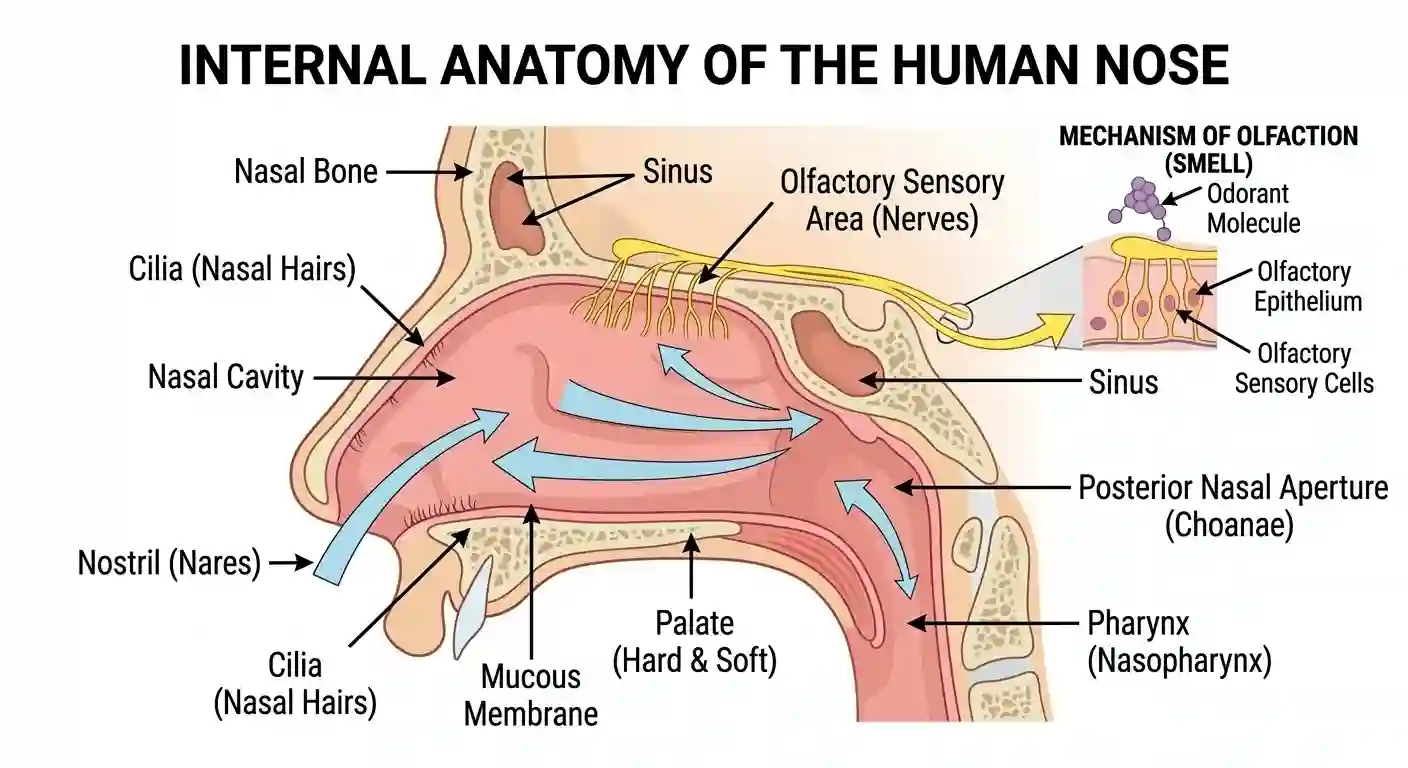
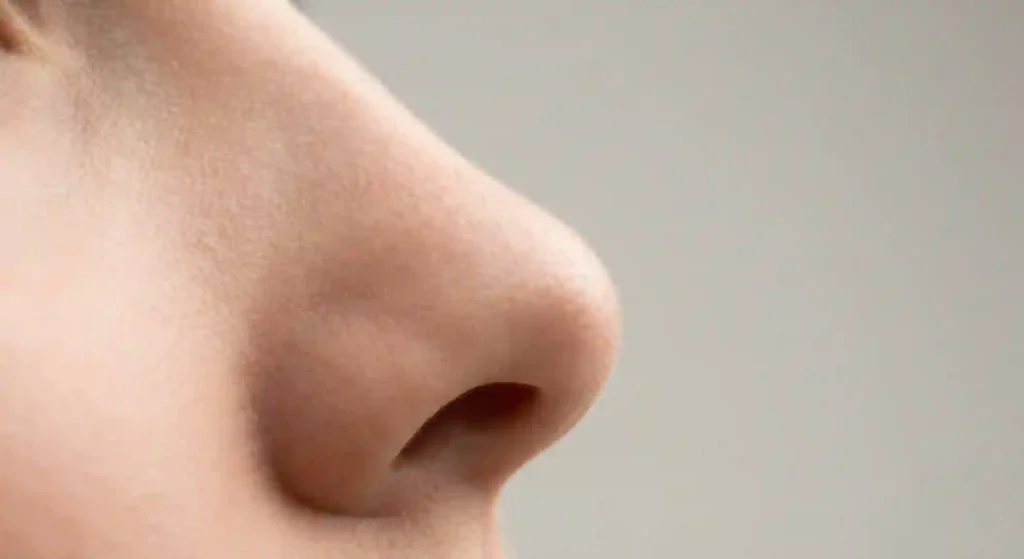
Hello Aspirants! Are you preparing for UPPSC, APPSC, TSPSC, SSC, RRB, DSC, Police, and other government job exams? Under General Science (Biology), Human Anatomy is a very important topic. In this article, we are providing the Human Nose Anatomy MCQ English to help you easily learn the questions related to the internal and external structure of the nose and its functions. We hope that each question and its detailed explanation provided here will definitely be helpful in making your preparation stronger.
1. General Structure of Nose – External & Internal Anatomy
1. The study of the nose and its diseases is called?
- A) Ophthalmology
- B) Dermatology
- C) Rhinology
- D) Otology
Answer
✅ Answer: C) Rhinology
Explanation
Explanation: Rhinology refers to the study of the nose and its diseases. The Greek word ‘Rhino’ means nose.
2. The medical department that studies and treats diseases of the ear, nose, and throat is known as?
- A) Neurology
- B) Pulmonology
- C) Otorhinolaryngology (ENT)
- D) Gastroenterology
Answer
✅ Answer: C) Otorhinolaryngology (ENT)
Explanation
Explanation: The medical specialty that deals with the diagnosis and treatment of diseases related to the ear, nose, and throat is called ENT or Otorhinolaryngology.
3. The upper part (bridge) of the external nose is made up of?
- A) Ligaments
- B) Cartilage
- C) Nasal bones
- D) Muscles
Answer
✅ Answer: C) Nasal bones
Explanation
Explanation: The hard structure located at the upper part of the nose is called the ‘Nasal bridge’. It is made up of nasal bones and provides support to the nose.
4. Which cartilage gives shape to the lower part of the nose?
- A) Fibrocartilage
- B) Elastic cartilage
- C) Calcified cartilage
- D) Hyaline cartilage
Answer
✅ Answer: D) Hyaline cartilage
Explanation
Explanation: The anterior (front) part of the nose is soft and flexible. ‘Hyaline cartilage’ helps in maintaining the specific shape of the nose.
5. The large, empty space present inside the nose is called?
- A) Nasal Cavity
- B) Vestibule
- C) Pharynx
- D) Choanae
Answer
✅ Answer: A) Nasal Cavity
Explanation
Explanation: The large, air-filled space situated behind the nose is known as the Nasal cavity. It acts as a passage to direct inhaled air towards the lungs.
6. The external openings through which air from the environment enters the nose are called?
- A) Nostrils / Nares
- B) Choanae
- C) Vestibule
- D) Glottis
Answer
✅ Answer: A) Nostrils / Nares
Explanation
Explanation: The two external openings located at the base of the nose, which connect the nasal cavity to the outside environment, are called Nostrils or External nares. Air enters the respiratory system through them.
7. The structure that divides the nasal cavity into two halves is called?
- A) Palate
- B) Nasal Septum
- C) Vomer bone
- D) Hard palate
Answer
✅ Answer: B) Nasal Septum
Explanation
Explanation: The central partition wall that divides the wide space of the nasal cavity into left and right halves is known as the ‘Nasal Septum’.
8. The Nasal septum is made up of?
- A) Only bones
- B) Only muscles
- C) Cartilage and Bone
- D) Only cartilage
Answer
✅ Answer: C) Cartilage and Bone
Explanation
Explanation: The anterior (front) portion of the nasal septum is composed of flexible cartilage, while the posterior (back) portion is formed by rigid bones.
9. Which is the major bone involved in the formation of the Nasal septum?
- A) Vomer bone
- B) Maxilla
- C) Frontal bone
- D) Nasal bone
Answer
✅ Answer: A) Vomer bone
Explanation
Explanation: The primary bone that forms the lower and posterior part of the nasal septum is the Vomer bone. It is accompanied by the perpendicular plate of the ethmoid bone.
2. Internal Structure & Functions
10. The thick hairs present inside the nostrils that help in filtration are called?
- A) Cilia
- B) Flagella
- C) Vibrissae
- D) Microvilli
Answer
✅ Answer: C) Vibrissae
Explanation
Explanation: The short, stiff hairs located inside the nostrils (vestibule) are called ‘Vibrissae’. They act as a coarse filter to prevent large dust particles and insects from entering the nasal cavity.
11. What are the primary defense structures that prevent environmental dust and dirt particles from reaching the lungs?
- A) Epiglottis
- B) Nose hairs and Mucus
- C) Larynx
- D) Trachea
Answer
✅ Answer: B) Nose hairs and Mucus
Explanation
Explanation: Nose hairs (vibrissae) block larger dust particles and bacteria. If smaller particles manage to pass, they get trapped in the sticky Mucus, thereby keeping the lungs safe and clean.
12. The tissue layer that lines the inner walls of the nasal cavity is called?
- A) Pleural Membrane
- B) Synovial Membrane
- C) Serous Membrane
- D) Mucous Membrane
Answer
✅ Answer: D) Mucous Membrane
Explanation
Explanation: The entire inner surface of the nasal cavity is lined by the Mucous membrane. It secretes mucus to trap foreign particles and keeps the inside of the nose constantly moist.
13. The openings at the back of the nasal cavity that lead into the pharynx are called?
- A) Internal nares or Choanae
- B) Vestibules
- C) Glottis
- D) External Nares
Answer
✅ Answer: A) Internal nares or Choanae
Explanation
Explanation: At the posterior (back) end of the nasal cavity, where it merges with the throat (pharynx), there are two openings known as ‘Choanae’ or internal nares.
14. Which glands are abundantly found in the skin over the upper part of the nose?
- A) Salivary glands
- B) Thyroid glands
- C) Sweat glands and Sebaceous glands
- D) Lacrimal glands
Answer
✅ Answer: C) Sweat glands and Sebaceous glands
Explanation
Explanation: The skin covering the nose contains a high concentration of sweat-producing glands as well as oil-secreting ‘Sebaceous’ glands. This is why the nose often feels oily.
15. If the nasal septum gets crooked or bent to one side for any reason, the condition is termed as?
- A) Rhinitis
- B) Deviated Nasal Septum (DNS)
- C) Nasal polyps
- D) Sinusitis
Answer
✅ Answer: B) Deviated Nasal Septum (DNS)
Explanation
Explanation: When the central dividing wall (septum) between the two nostrils leans or bends to one side, it is known as DNS (Deviated Nasal Septum). It can cause breathing difficulties.
3. Breathing & Characteristics
16. What are the two primary functions performed by the human nose?
- A) Breathing and Tasting
- B) Breathing and Hearing
- C) Smelling and Speaking
- D) Breathing and Smelling
Answer
✅ Answer: D) Breathing and Smelling
Explanation
Explanation: The nose mainly performs two crucial functions: 1. Acting as an airway for respiration (Breathing) and 2. Detecting odors through olfactory receptors (Smelling).
17. The initial space just inside the nostrils is called?
- A) Choanae
- B) Vestibule
- C) Nasal cavity
- D) Sinus
Answer
✅ Answer: B) Vestibule
Explanation
Explanation: Upon entering through the external nostrils, the first slightly dilated, hair-lined space encountered is known as the Vestibule. This is where vibrissae aid in preliminary filtration.
18. Where does the inhaled air first get warmed in the respiratory tract?
- A) In the Trachea
- B) In the Lungs
- C) In the Nasal Cavity
- D) In the Pharynx
Answer
✅ Answer: C) In the Nasal Cavity
Explanation
Explanation: As cold air from the outside enters the nose, it is warmed to match body temperature by the rich network of blood capillaries present in the Nasal cavity. This is part of the air conditioning process.
19. Which duct helps in draining tears from the eyes into the nasal cavity?
- A) Eustachian tube
- B) Optic duct
- C) Para nasal duct
- D) Nasolacrimal duct
Answer
✅ Answer: D) Nasolacrimal duct
Explanation
Explanation: The small tube that carries excess tears produced by the lacrimal glands in the eyes down into the nasal cavity is called the ‘Nasolacrimal duct’.
20. What is the reason for a runny nose when a person cries?
- A) Swelling of nasal blood vessels
- B) Tears flowing into the nose through the nasolacrimal duct
- C) Excessive secretion of mucus
- D) Dilation of nostrils
Answer
✅ Answer: B) Tears flowing into the nose through the nasolacrimal duct
Explanation
Explanation: When crying, the eyes produce excess tears. These tears drain directly into the nasal cavity via the nasolacrimal duct and flow out through the nostrils, resulting in a runny nose.
Aspirants! In this post, we have practiced important questions related to Human Nose Anatomy MCQ English. We hope this article has given you a clear understanding of the external and internal structure of the nose. These questions will be highly useful for your upcoming competitive exams.
🔗 For More Information: If you want to learn about the Human Nose in more detail, you can read on Wikipedia.
Note: If you find this information useful, please share it with your friends preparing for competitive exams. Also, if you have any questions or valuable suggestions, please let us know through our email [email protected].