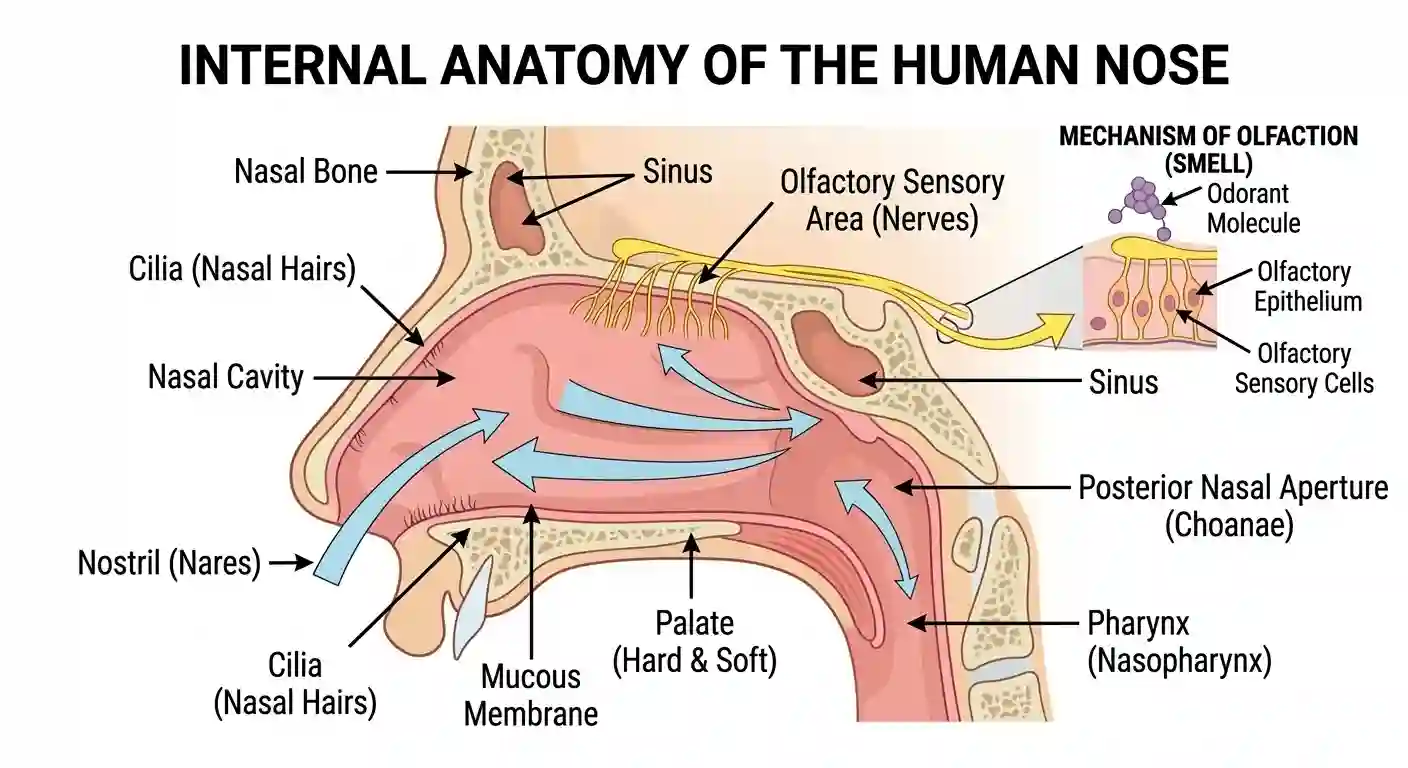
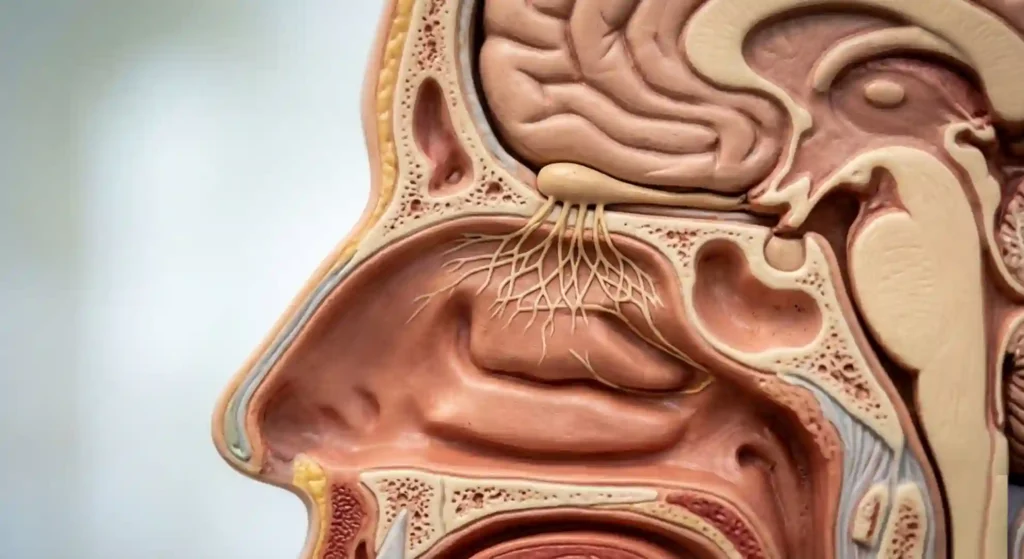
Hello Aspirants! Are you preparing for UPPSC, APPSC, TSPSC, SSC, RRB, DSC, Police, and other government job exams? Under General Science (Biology), the sensory organs play a vital role. In this article, we are providing the Human Olfactory System MCQ English to help you easily understand the mechanism of smelling, the olfactory nerve, and how our brain processes odors. We hope these carefully selected practice questions will definitely make your preparation stronger.
3: Olfactory Process, Role in Breathing & Air Filtration
41. The filtration of air in the nose is primarily carried out by which parts?
- A) Turbinates and Olfactory bulb
- B) Nasal hairs and Mucus
- C) Sinuses and Choanae
- D) Epiglottis and Trachea
Answer
✅ Answer: B) Nasal hairs and Mucus
Explanation
Explanation: The dust and dirt particles in the air are filtered out by the stiff hairs (Vibrissae) at the nostrils and the sticky mucus inside the nasal cavity, preventing them from reaching the lungs.
42. How is the cold atmospheric air warmed up to body temperature as it passes through the nose?
- A) Through the network of blood capillaries inside the nose
- B) By the air present in the sinus cavities
- C) By the heating effect of the olfactory nerve
- D) Through the friction caused by the nasal septum
Answer
✅ Answer: A) Through the network of blood capillaries inside the nose
Explanation
Explanation: Underneath the inner lining of the nose (turbinates), there is a rich supply of blood capillaries. When we inhale, the heat from these blood vessels warms the cold air to match our body temperature.
43. Which part of the nose is responsible for providing moisture (humidification) to the inhaled air?
- A) Salivary glands
- B) Tear glands
- C) The mucus secreted by the mucous membrane
- D) Sweat glands
Answer
✅ Answer: C) The mucus secreted by the mucous membrane
Explanation
Explanation: Dry air is harmful to the delicate tissues of the lungs. Therefore, the moisture present in the mucus secreted by the mucous membrane hydrates (humidifies) the inhaled air.
44. When we breathe through the nose, what is the correct path taken by the air to reach the lungs?
- A) Nose → Trachea → Pharynx → Lungs
- B) Nose → Pharynx → Trachea → Lungs
- C) Nose → Esophagus → Trachea → Lungs
- D) Nose → Lungs → Pharynx
Answer
✅ Answer: B) Nose → Pharynx → Trachea → Lungs
Explanation
Explanation: From the nasal cavity, the air first enters the throat (Pharynx), passes through the voice box (Larynx), goes down the windpipe (Trachea), and finally reaches the lungs.
45. What is the first step in the process of smelling?
- A) The brain sending a signal
- B) Air entering the lungs
- C) Odor particles in the air reaching the olfactory epithelium
- D) Activation of Kiesselbach’s plexus
Answer
✅ Answer: C) Odor particles in the air reaching the olfactory epithelium
Explanation
Explanation: When we inhale, the first step in smelling occurs when the odor-causing particles (odorants) in the air travel up and reach the olfactory epithelium situated at the roof of the nasal cavity.
46. What are the chemical molecules present in the air that cause a smell called?
- A) Pheromones
- B) Hormones
- C) Odorants
- D) Enzymes
Answer
✅ Answer: C) Odorants
Explanation
Explanation: A smell or scent is caused by volatile chemicals dissolved in the air. These microscopic chemical molecules that emit an odor are scientifically known as ‘Odorants’.
47. After dissolving in the nasal mucus, what do the odorants bind to?
- A) Olfactory receptor proteins
- B) Hemoglobin
- C) Cilia
- D) Mast cells
Answer
✅ Answer: A) Olfactory receptor proteins
Explanation
Explanation: Once the odorants dissolve in the mucus, they bind to specific olfactory receptor proteins present on the surface of the olfactory cilia (like a lock and key mechanism), thereby stimulating the nerve cells.
48. Through which nerve do the electrical signals (action potentials) generated by activated smell receptors travel?
- A) Optic nerve
- B) Trigeminal nerve
- C) Facial nerve
- D) Olfactory nerve
Answer
✅ Answer: D) Olfactory nerve
Explanation
Explanation: After the chemical signals are converted into electrical impulses, the Olfactory nerve (the 1st cranial nerve) carries these impulses straight to the olfactory bulb in the brain.
49. What is the approximate area covered by the olfactory region in the human nose?
- A) 1 square centimeter
- B) About 5 square centimeters
- C) 10 square centimeters
- D) 20 square centimeters
Answer
✅ Answer: B) About 5 square centimeters
Explanation
Explanation: Compared to dogs, the olfactory epithelium in humans is quite small. It covers an area of approximately 5 square centimeters (5 sq cm) on both sides at the roof of the nasal cavity.
50. During respiration, which gas does the nose primarily take in?
- A) Nitrogen
- B) Carbon dioxide
- C) Oxygen
- D) Hydrogen
Answer
✅ Answer: C) Oxygen
Explanation
Explanation: During the process of inhalation (breathing in), we take in air that is rich in Oxygen through the nose to supply it to the lungs.
51. During respiration, which gas does the nose expel out of the body?
- A) Oxygen
- B) Carbon dioxide
- C) Argon
- D) Helium
Answer
✅ Answer: B) Carbon dioxide
Explanation
Explanation: During exhalation (breathing out), the waste gas produced by cellular respiration, known as ‘Carbon dioxide’, is expelled out of the body through the nose.
52. What is it called when you stop perceiving a smell after being continuously exposed to it for some time?
- A) Anosmia
- B) Parosmia
- C) Olfactory Fatigue (Adaptation)
- D) Hyperosmia
Answer
✅ Answer: C) Olfactory Fatigue (Adaptation)
Explanation
Explanation: When you apply perfume, you smell it strongly at first, but after a while, you can no longer smell it (though others can). This temporary inability to distinguish a particular odor after prolonged exposure is called Sensory Adaptation or Olfactory Fatigue.
53. When we take a deep, sharp breath to smell something (sniffing), to which part of the nose does the air mostly go?
- A) To the trachea
- B) To the olfactory epithelium
- C) To the nasal septum
- D) To the sinus cavities
Answer
✅ Answer: B) To the olfactory epithelium
Explanation
Explanation: Normally, inhaled air flows through the lower part of the nose. But when we sniff forcefully to detect a scent, the air is directed upwards straight to the Olfactory Epithelium, making the smell more intense.
54. Why is breathing through the nose considered healthier than breathing through the mouth?
- A) Because less air comes through the mouth
- B) Because the nose filters, warms, and humidifies the air
- C) Because only oxygen travels through the nose
- D) Because air cannot enter through the mouth
Answer
✅ Answer: B) Because the nose filters, warms, and humidifies the air
Explanation
Explanation: The mouth merely acts as a passage for air. However, the nose functions like an air conditioner by filtering out dust, warming the air, and adding moisture (conditioning) before safely delivering it to the lungs.
55. How does the nose contribute to the modulation of our voice?
- A) It controls the larynx
- B) It acts as a resonating chamber
- C) It absorbs sound
- D) It stops the airflow
Answer
✅ Answer: B) It acts as a resonating chamber
Explanation
Explanation: The nasal cavity and paranasal sinuses act as a ‘Resonating chamber’ that adds a unique tone and depth to our voice. That is why our voice sounds different and ‘stuffy’ when we have a cold and the nose gets blocked.
56. Where are the dust particles in inhaled air primarily filtered out to prevent them from entering the windpipe?
- A) In the nasal cavity
- B) In the alveoli of the lungs
- C) In the heart
- D) In the esophagus
Answer
✅ Answer: A) In the nasal cavity
Explanation
Explanation: Before the dust and dirt particles in the air can reach the trachea (windpipe) and lungs, they are predominantly filtered and trapped inside the nasal cavity by hairs and mucus.
57. The swelling of the nasal tissues resulting in blocked airflow is medically termed as?
- A) Anosmia
- B) Epistaxis
- C) Nasal Congestion
- D) Sinusitis
Answer
✅ Answer: C) Nasal Congestion
Explanation
Explanation: When you have a cold or allergies, the blood vessels and tissues in the nose swell up, and excess mucus is produced, obstructing the flow of air. This uncomfortable condition is known as Nasal Congestion or a stuffy nose.
58. The inability to perceive smell present from birth is known as?
- A) Congenital Anosmia
- B) Phantosmia
- C) Parosmia
- D) Presbyosmia
Answer
✅ Answer: A) Congenital Anosmia
Explanation
Explanation: Due to genetic defects or improper development of the olfactory system during gestation, some individuals are born without the sense of smell. This lifelong condition is called Congenital Anosmia.
59. The illusion of smelling odors (especially foul ones) that are not actually present in the environment is called?
- A) Cacosmia
- B) Hyperosmia
- C) Phantosmia
- D) Hyposmia
Answer
✅ Answer: C) Phantosmia
Explanation
Explanation: Phantosmia is an olfactory hallucination where a person perceives smells—such as smoke, burning rubber, or chemical odors—when no such physical odors actually exist around them.
60. Damage to which nerve inside the nose due to severe head trauma can result in a permanent loss of smell?
- A) Trigeminal nerve
- B) Optic nerve
- C) Olfactory nerve
- D) Facial nerve
Answer
✅ Answer: C) Olfactory nerve
Explanation
Explanation: If a person suffers a severe blow to the head or face resulting in fractures to the ethmoid bone, the delicate Olfactory nerve fibers can be severed. This kind of nerve damage can cause a permanent loss of smell.
Aspirants! In this post, we have practiced important questions related to the Human Olfactory System MCQ English. We hope this article has given you a clear understanding of the olfactory receptors, olfactory bulb, and the entire mechanism of smelling. These questions will be highly useful for your upcoming competitive exams.
🔗 For More Information: If you want to learn about the Olfactory System in more detail, you can read on Wikipedia.
Note: If you find this information useful, please share it with your friends preparing for competitive exams. Also, if you have any questions or valuable suggestions, please let us know through our email [email protected].