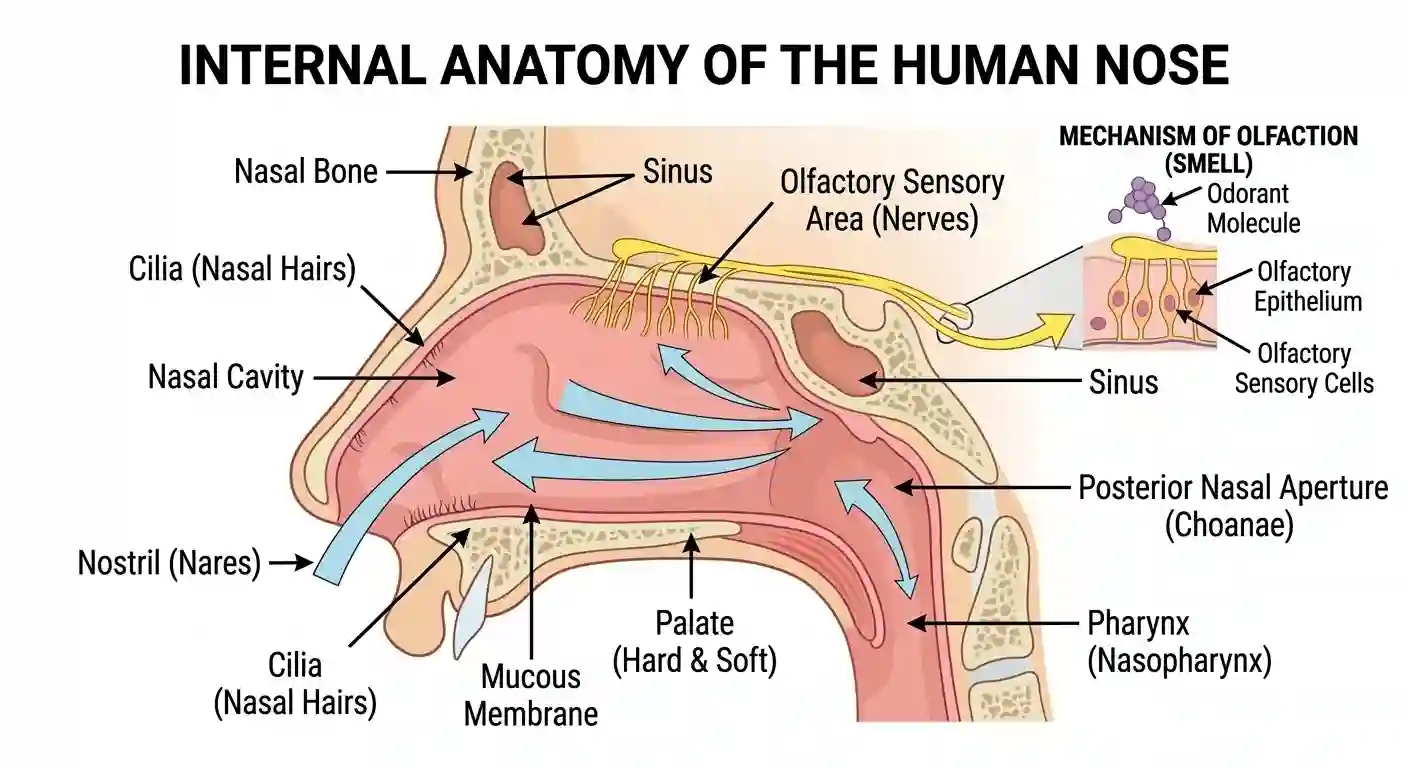
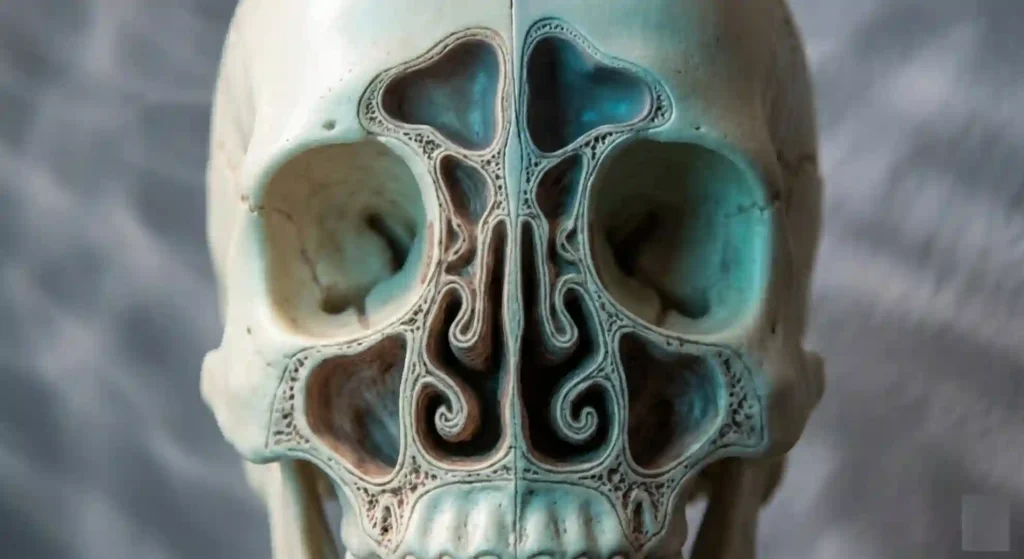
Hello Aspirants! Are you preparing for UPPSC, APPSC, TSPSC, SSC, RRB, DSC, Police, and other government job exams? Under General Science (Biology), the sensory organs play a vital role. In this article, we are providing the Paranasal Sinuses MCQ English to help you easily understand the different types of sinuses, their locations, and their functions like air filtration and voice resonance. We hope these carefully selected practice questions will definitely make your preparation stronger.
4: Paranasal Sinuses, Blood & Nerve Supply
61. What are the air-filled empty spaces in the skull bones around the nose called?
- A) Alveoli
- B) Paranasal Sinuses
- C) Turbinates
- D) Choanae
Answer
✅ Answer: B) Paranasal Sinuses
Explanation
Explanation: The air-filled chambers or empty spaces in the skull bones surrounding the nose are called Paranasal Sinuses. They help warm the air we breathe.
62. How many pairs of paranasal sinuses are there in the human body?
- A) Two pairs
- B) Three pairs
- C) Four pairs
- D) Six pairs
Answer
✅ Answer: C) Four pairs
Explanation
Explanation: There are primarily four pairs (eight in total) of paranasal sinuses located in the skull bones around the human nose.
63. What are those four types of sinuses?
- A) Frontal, Parietal, Occipital, Temporal
- B) Cervical, Thoracic, Lumbar, Sacral
- C) Superior, Middle, Inferior, Conchae
- D) Frontal, Maxillary, Ethmoid, and Sphenoid sinuses
Answer
✅ Answer: D) Frontal, Maxillary, Ethmoid, and Sphenoid sinuses
Explanation
Explanation: These four sinuses are named according to the facial bones they are located in (Frontal, Maxillary, Ethmoid, and Sphenoid bones).
64. Which sinuses are located above the eyes in the forehead region?
- A) Maxillary sinuses
- B) Frontal sinuses
- C) Ethmoid sinuses
- D) Sphenoid sinuses
Answer
✅ Answer: B) Frontal sinuses
Explanation
Explanation: The frontal bone is the forehead bone. The sinuses located above the eyes in the forehead region are called Frontal sinuses.
65. Which are the largest sinuses located below the eyes in the cheek area?
- A) Ethmoid sinuses
- B) Frontal sinuses
- C) Sphenoid sinuses
- D) Maxillary sinuses
Answer
✅ Answer: D) Maxillary sinuses
Explanation
Explanation: The upper jawbone under the cheeks is called the ‘Maxilla’. The maxillary sinuses located here are the largest of all the paranasal sinuses.
66. What is the primary function of the sinuses?
- A) Storing blood
- B) Decreasing the weight of the skull and increasing voice resonance
- C) Completely stopping mucus
- D) Cooling the brain
Answer
✅ Answer: B) Decreasing the weight of the skull and increasing voice resonance
Explanation
Explanation: Because sinuses are filled with air, they reduce the overall weight of the skull. They also act as resonating chambers that give a unique tone (voice resonance) when we speak.
67. The inner lining of the sinuses is covered with?
- A) Dura mater
- B) Pleura
- C) Mucous membrane
- D) Pericardium
Answer
✅ Answer: C) Mucous membrane
Explanation
Explanation: Just like the inside of the nose, the inner walls of the sinuses are also covered with a mucous membrane that continuously produces mucus.
68. Which are the main arteries that supply blood to the nose?
- A) Pulmonary arteries
- B) Branches of the Internal and External Carotid arteries
- C) Coronary arteries
- D) Hepatic arteries
Answer
✅ Answer: B) Branches of the Internal and External Carotid arteries
Explanation
Explanation: Small branches from the internal and external carotid arteries, which travel up the neck to the head, supply blood to the nose and face.
69. What is the area in the anterior part of the nasal septum where blood vessels form a network called?
- A) Kiesselbach’s plexus / Little’s area
- B) Broca’s area
- C) Wernicke’s area
- D) Olfactory bulb
Answer
✅ Answer: A) Kiesselbach’s plexus / Little’s area
Explanation
Explanation: In the lower anterior part of the nasal septum, five blood vessels intertwine to form a network. This area is known as Little’s area or Kiesselbach’s plexus.
70. Which is the most common site for a nosebleed (Epistaxis)?
- A) Olfactory epithelium
- B) Nostrils
- C) Kiesselbach’s plexus (Little’s area)
- D) Choanae
Answer
✅ Answer: C) Kiesselbach’s plexus (Little’s area)
Explanation
Explanation: At Kiesselbach’s plexus, the blood vessels are very thin and close to the skin’s surface. That is why even a minor injury or extreme heat commonly causes a nosebleed from here.
71. Frequent bleeding from the nose is medically termed as?
- A) Hemoptysis
- B) Epistaxis
- C) Hematemesis
- D) Anosmia
Answer
✅ Answer: B) Epistaxis
Explanation
Explanation: The medical term for a condition where blood vessels inside the nose rupture and bleed (nosebleed) is called Epistaxis.
72. Which are the main cranial nerves that supply the muscles and skin of the nose?
- A) Optic and Vagus nerves
- B) Olfactory and Optic nerves
- C) Trigeminal nerve and Facial nerve
- D) Auditory and Glossopharyngeal nerves
Answer
✅ Answer: C) Trigeminal nerve and Facial nerve
Explanation
Explanation: The facial nerve (7th cranial nerve) controls the movement of facial and nasal muscles, while the trigeminal nerve (5th cranial nerve) provides sensation to the skin of the nose.
73. In the nerve supply of the nose, which nerve senses touch, pain, and temperature?
- A) Olfactory nerve
- B) Vagus nerve
- C) Facial nerve
- D) Trigeminal nerve (5th cranial nerve)
Answer
✅ Answer: D) Trigeminal nerve (5th cranial nerve)
Explanation
Explanation: While the olfactory nerve detects smell through the nose, the sensations of pain, cold, and heat in the nose are perceived by the trigeminal nerve.
74. Which enzyme present in the mucus destroys bacteria in the air we breathe?
- A) Amylase
- B) Pepsin
- C) Lysozyme
- D) Lipase
Answer
✅ Answer: C) Lysozyme
Explanation
Explanation: Lysozyme is a naturally occurring enzyme that breaks down and destroys bacterial cell walls. It is abundant in mucus, tears, and saliva.
75. Which is the main antibody providing immunity in the mucus inside the nose?
- A) Immunoglobulin-G (IgG)
- B) Immunoglobulin-A (IgA)
- C) Immunoglobulin-M (IgM)
- D) Immunoglobulin-E (IgE)
Answer
✅ Answer: B) Immunoglobulin-A (IgA)
Explanation
Explanation: Immunoglobulin-A (IgA) is the primary antibody that prevents infections at mucosal linings such as the respiratory tract, nasal cavity, and digestive tract.
76. Which organ acts as the gateway to the respiratory system?
- A) Mouth
- B) Throat
- C) Nose
- D) Lungs
Answer
✅ Answer: C) Nose
Explanation
Explanation: The human respiratory system starts from the nose and extends to the lungs. The nose acts as its main entrance or gateway.
77. Along with the tongue, which sense plays a key role in enjoying the full flavor of food?
- A) Sense of hearing
- B) Sense of sight
- C) Sense of touch
- D) Sense of smell (Olfaction)
Answer
✅ Answer: D) Sense of smell (Olfaction)
Explanation
Explanation: The complete flavor of the food we eat is determined not only by the tongue but also by the nose (smell). The true flavor is experienced only when both work together.
78. Why does food taste bland when you have a cold?
- A) Because the tongue stops working
- B) Because the olfactory receptors get blocked by mucus
- C) Because of a sore throat
- D) Because saliva production stops
Answer
✅ Answer: B) Because the olfactory receptors get blocked by mucus
Explanation
Explanation: During a cold, a thick layer of mucus builds up over the olfactory epithelium (smell receptors). Food doesn’t taste good because the sense of smell is temporarily lost.
79. Which structures in the nose create turbulence in the air, causing it to spread throughout the nasal cavity?
- A) Nasal septum
- B) Cilia
- C) Turbinates
- D) Olfactory bulb
Answer
✅ Answer: C) Turbinates
Explanation
Explanation: The curved, scroll-like shape of the turbinates creates a swirling motion (turbulence) as air enters the nose. This causes the air to stay longer in the nose and become warm.
80. Which system in the brain plays a key role in remembering smells and triggering emotions?
- A) Limbic System
- B) Cerebral cortex
- C) Medulla oblongata
- D) Brain stem
Answer
✅ Answer: A) Limbic System
Explanation
Explanation: The olfactory nerve is directly connected to the limbic system (the center for emotions and memory) in the brain. That is why smelling certain odors instantly brings back old memories.
Aspirants! In this post, we have practiced important questions related to the Paranasal Sinuses MCQ English. We hope this article has given you a clear understanding of the maxillary, frontal, ethmoid, and sphenoid sinuses, along with their roles in the human body. These questions will be highly useful for your upcoming competitive exams.
🔗 For More Information: If you want to learn about the Paranasal Sinuses in more detail, you can read on Wikipedia.
Note: If you find this information useful, please share it with your friends preparing for competitive exams. Also, if you have any questions or valuable suggestions, please let us know through our email [email protected].