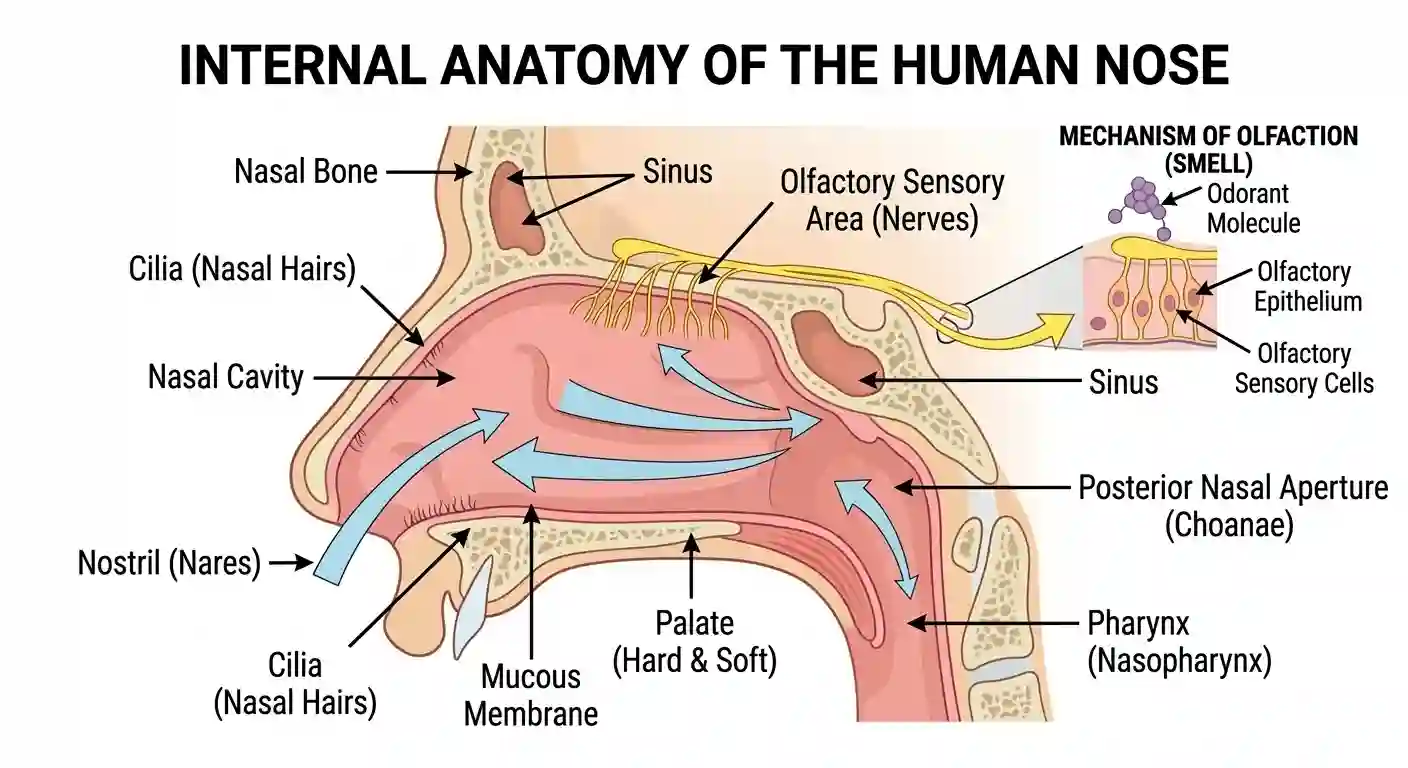
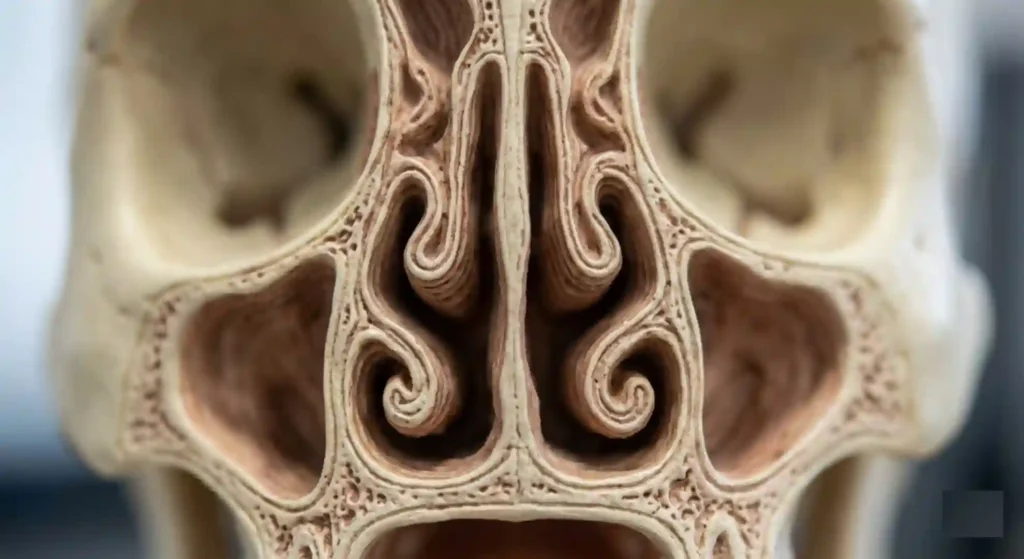
Hello Students! Are you preparing for competitive exams like SSC, RRB, State PSCs, or Police exams? Under General Science (Biology), ‘Human Nose and Sensory Organs’ is a very important topic. In this article, we are providing the Nasal Cavity Turbinates MCQ English to help you easily understand the functions of turbinates, cilia, and the mucous membrane inside the nose. We hope these practice questions will strengthen your preparation.
2. Turbinates, Cilia, Mucous Membrane & Olfactory System
21. The scroll-like bony structures present on the lateral walls of the nasal cavity are called?
- A) Vibrissae
- B) Nasal Septum
- C) Nasal Conchae or Turbinates
- D) Choanae
Answer
✅ Answer: C) Nasal Conchae or Turbinates
Explanation
Explanation: The protruding, scroll-like (folded) bony structures on the lateral walls of the nasal cavity are called Turbinates or Nasal Conchae.
22. How many main pairs of turbinates are there in the human nose?
- A) One pair
- B) Two pairs
- C) Three pairs (Superior, Middle, Inferior)
- D) Four pairs
Answer
✅ Answer: C) Three pairs (Superior, Middle, Inferior)
Explanation
Explanation: There are mainly three pairs of turbinates in the nose. They are the superior turbinates at the top, the middle turbinates in the center, and the inferior turbinates at the bottom.
23. Which parts of the nose slowly warm the air by increasing the surface area over which the air passes?
- A) Turbinates
- B) Cilia
- C) Nose hairs
- D) Olfactory bulb
Answer
✅ Answer: A) Turbinates
Explanation
Explanation: Turbinates increase the surface area within the nasal cavity, causing the inhaled air to slow down. This allows the air to become adequately warmed (to body temperature) and humidified.
24. What secretion is continuously produced by the mucous membrane?
- A) Saliva
- B) Mucus
- C) Tears
- D) Sebum
Answer
✅ Answer: B) Mucus
Explanation
Explanation: The mucous membrane lining the walls of the nasal cavity continuously produces a sticky secretion called Mucus, which prevents the inside of the nose from drying out.
25. What are the specialized cells in the nose that secrete mucus called?
- A) Stem cells
- B) Kupffer cells
- C) Goblet cells
- D) Mast cells
Answer
✅ Answer: C) Goblet cells
Explanation
Explanation: ‘Goblet cells’ present in the epithelial layer of the respiratory tract and nasal cavity continuously secrete mucus to trap dust and dirt.
26. The microscopic, hair-like structures present on the mucous membrane are called?
- A) Vibrissae
- B) Cilia
- C) Flagella
- D) Microvilli
Answer
✅ Answer: B) Cilia
Explanation
Explanation: There are very fine, microscopic hair-like structures on top of the mucous membrane of the nose, which are not visible to the naked eye. These are called ‘Cilia’.
27. Which structures push the mucus containing trapped bacteria and dust toward the throat?
- A) Turbinates
- B) Nostrils
- C) Goblet cells
- D) Cilia
Answer
✅ Answer: D) Cilia
Explanation
Explanation: Cilia continuously perform a sweeping motion, pushing the mucus laden with dust and bacteria backward (towards the throat) to be cleared.
28. The process of sweeping dust-laden mucus into the throat via ciliary movement, which is then swallowed, is called?
- A) Mucociliary clearance
- B) Phagocytosis
- C) Deglutition
- D) Peristalsis
Answer
✅ Answer: A) Mucociliary clearance
Explanation
Explanation: The remarkable self-clearing mechanism where cilia sweep impure mucus to the throat, from where it is sent to the stomach and destroyed by acids, is called ‘Mucociliary clearance’.
29. In which part of the nose are the cells responsible for detecting smell located?
- A) At the floor of the nasal cavity
- B) At the roof of the nasal cavity (Olfactory epithelium)
- C) Near the nostrils
- D) On top of the nasal septum
Answer
✅ Answer: B) At the roof of the nasal cavity (Olfactory epithelium)
Explanation
Explanation: The cells that detect smell are located like a small patch on the roof of the nasal cavity. This specialized area is called the Olfactory epithelium.
30. The receptors in the nose that receive smell are called?
- A) Thermoreceptors
- B) Gustatory Receptors
- C) Olfactory Receptors
- D) Photoreceptors
Answer
✅ Answer: C) Olfactory Receptors
Explanation
Explanation: The specialized nerve cells or receptors that detect various odors entering the nose through the air are called Olfactory receptors.
31. What type of cells are olfactory receptors?
- A) Chemoreceptors
- B) Mechanoreceptors
- C) Baroreceptors
- D) Photoreceptors
Answer
✅ Answer: A) Chemoreceptors
Explanation
Explanation: Odors are essentially chemicals dissolved in the air. Since olfactory receptors detect and respond to these chemicals, they are classified as ‘Chemoreceptors’.
32. Which nerve carries the smell signals received by the nose to the brain?
- A) Optic nerve
- B) Vagus nerve
- C) Trigeminal nerve
- D) Olfactory nerve (1st cranial nerve)
Answer
✅ Answer: D) Olfactory nerve (1st cranial nerve)
Explanation
Explanation: The Olfactory nerve is responsible for transmitting smell signals from the olfactory cells in the nose to the brain. It is the first of the human cranial nerves.
33. Which part of the brain analyzes smell signals?
- A) Cerebellum
- B) Olfactory bulb and Olfactory cortex
- C) Occipital lobe
- D) Medulla oblongata
Answer
✅ Answer: B) Olfactory bulb and Olfactory cortex
Explanation
Explanation: Nerve signals related to smell first travel to the ‘Olfactory bulb’ of the brain, and then proceed to the ‘Olfactory cortex’ for interpretation and analysis.
34. The complete loss of the ability to smell is called?
- A) Anosmia
- B) Myopia
- C) Hypoxia
- D) Amnesia
Answer
✅ Answer: A) Anosmia
Explanation
Explanation: The medical condition characterized by a total loss of the sense of smell due to illness, injury, or infection (e.g., COVID-19) is called Anosmia.
35. We can detect a smell only when the chemicals in the air dissolve in which fluid of the nose?
- A) Saliva
- B) Tears
- C) Mucus
- D) Blood
Answer
✅ Answer: C) Mucus
Explanation
Explanation: When we inhale an odor, the odorant molecules must dissolve in the moist mucus lining the nose before the olfactory receptors can detect them. If the nose is completely dry, smell cannot be perceived.
36. Compared to animals like dogs, humans have a reduced ability in which of the following?
- A) Sense of hearing
- B) Sense of sight
- C) Sense of smell (Microsmatic)
- D) Sense of taste
Answer
✅ Answer: C) Sense of smell (Microsmatic)
Explanation
Explanation: Compared to animals like dogs and mice, the olfactory epithelium in humans is very small, leading to a weaker sense of smell. Therefore, humans are considered ‘Microsmatic’ creatures.
37. Olfactory cells belong to which part of the nervous system?
- A) Autonomic Nervous System
- B) Central Nervous System (CNS)
- C) Peripheral Nervous System
- D) Sympathetic Nervous System
Answer
✅ Answer: B) Central Nervous System (CNS)
Explanation
Explanation: Although olfactory receptor cells are located in the nose, they are actually a direct extension of the brain and belong to the Central Nervous System (CNS).
38. Roughly how many types of odors can a human being distinguish?
- A) 500 types
- B) 1,000 types
- C) More than 10,000 types
- D) More than a million types
Answer
✅ Answer: C) More than 10,000 types
Explanation
Explanation: According to scientific estimates, a normal human can distinguish and identify more than 10,000 different odors with the help of olfactory receptors present in the nose.
39. The natural decline in the sense of smell associated with aging is called?
- A) Anosmia
- B) Parosmia
- C) Hyperosmia
- D) Presbyosmia
Answer
✅ Answer: D) Presbyosmia
Explanation
Explanation: Just as eyesight weakens with old age, the gradual loss of the ability to smell due to a decrease in the number of olfactory receptor cells with age is called Presbyosmia.
40. The distortion of the sense of smell, where familiar odors smell wrong or foul, is known as?
- A) Parosmia
- B) Anosmia
- C) Presbyosmia
- D) Hyperosmia
Answer
✅ Answer: A) Parosmia
Explanation
Explanation: Parosmia is a condition where a person’s perception of smell is altered; for example, a pleasant smell might suddenly be perceived as a foul, burnt, or rotting odor.
Aspirants! In this post, we have practiced important questions related to Nasal Cavity Turbinates MCQ English. We hope this article has given you a clear understanding of the functions of the nasal cavity, turbinates, cilia, and mucous membrane. These questions will be highly useful for your upcoming competitive exams.
🔗 For More Information: If you want to learn about the Nasal Cavity in more detail, you can read on Wikipedia.
Note: If you find this information useful, please share it with your friends preparing for competitive exams. Also, if you have any questions or valuable suggestions, please let us know through our email jobspreparationofficial@gmail.com.