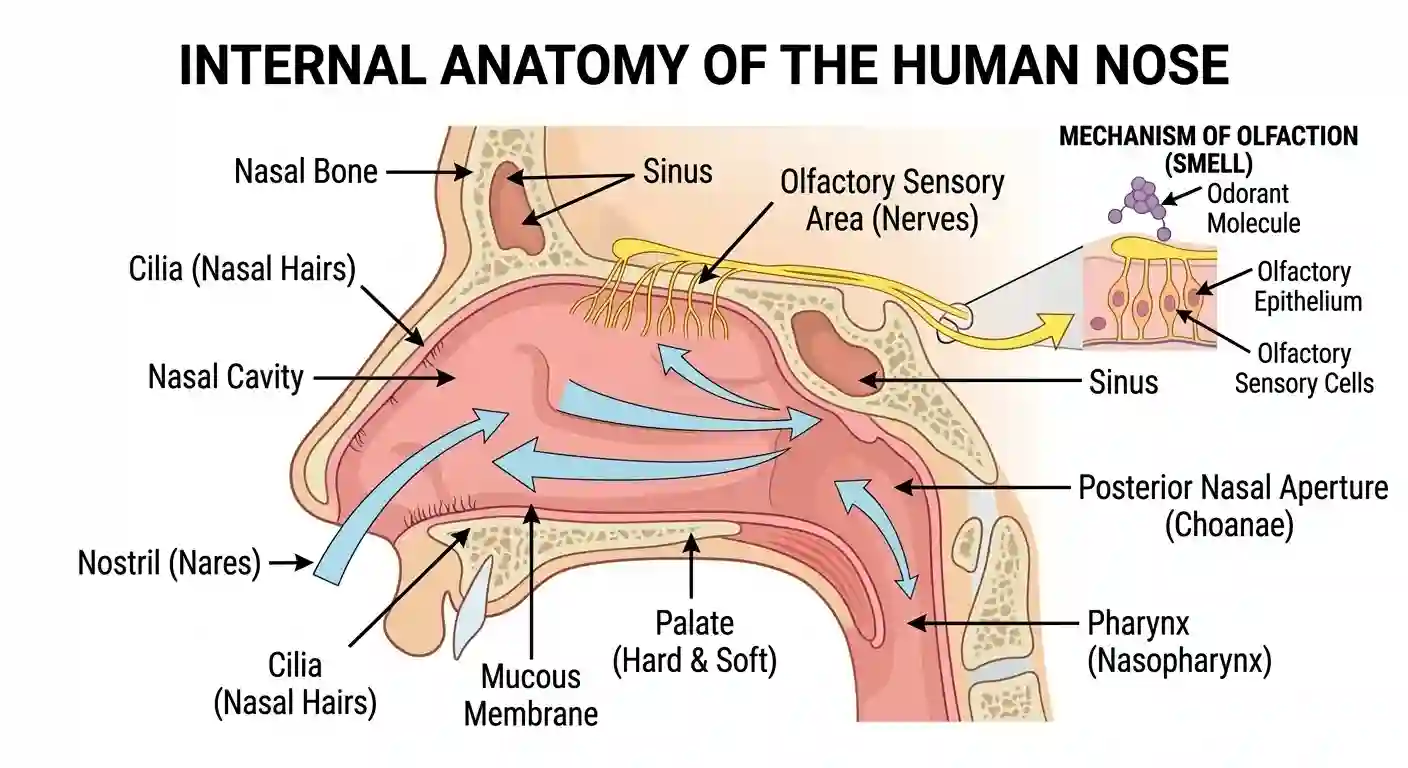
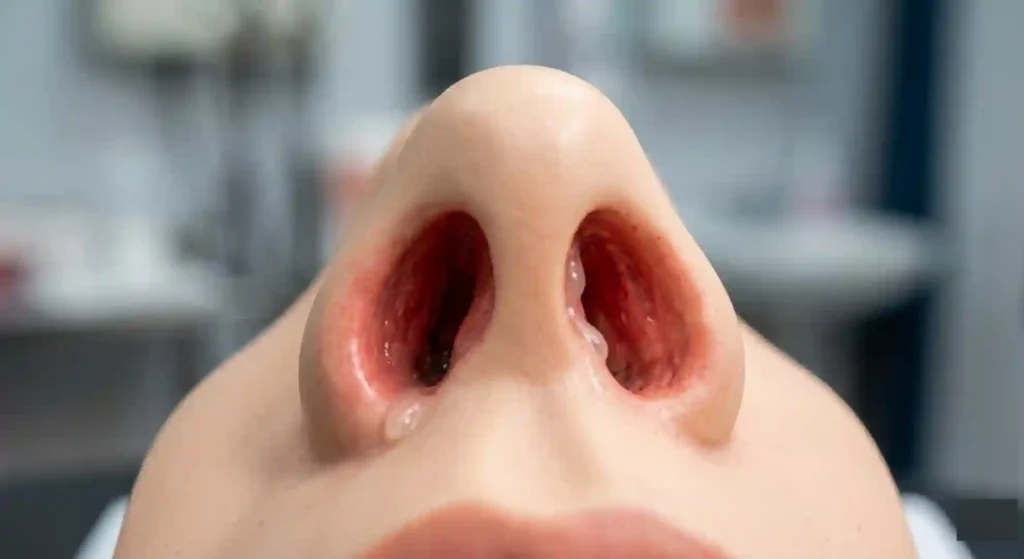
Hello Aspirants! Are you preparing for UPPSC, APPSC, TSPSC, SSC, RRB, DSC, Police, and other government job exams? Under General Science (Biology), the study of human diseases and disorders is highly important. In this article, we are providing the Human Nose Diseases MCQ English to help you easily understand common nasal conditions like sinusitis, rhinitis, deviated nasal septum (DNS), and their symptoms. We hope these carefully selected practice questions will definitely make your preparation stronger.
5: Common Diseases of the Nose
81. Which of the following is the most common infection related to the nose?
- A) Sinusitis
- B) Common Cold
- C) Nasal Polyps
- D) Anosmia
Answer
✅ Answer: B) Common Cold
Explanation
Explanation: The ‘Common Cold’ is the most frequent infection affecting the nose and throat, impacting humans worldwide more than any other disease.
82. The common cold is primarily caused by?
- A) Bacteria
- B) Fungus
- C) Protozoa
- D) Viral infection (especially Rhinovirus)
Answer
✅ Answer: D) Viral infection (especially Rhinovirus)
Explanation
Explanation: The common cold is primarily a viral infection of the upper respiratory tract. Among the many viruses that cause it, the ‘Rhinovirus’ is the most common culprit.
83. Swelling, inflammation, or infection of the paranasal sinuses is known as?
- A) Rhinitis
- B) Pharyngitis
- C) Sinusitis
- D) Laryngitis
Answer
✅ Answer: C) Sinusitis
Explanation
Explanation: When the sinus cavities around the nose get infected, they become inflamed and fill up with mucus. This painful condition is called Sinusitis.
84. What is the primary symptom of Sinusitis?
- A) Joint pain
- B) Facial pain, headache, and nasal congestion
- C) Loss of hearing
- D) Reduced vision
Answer
✅ Answer: B) Facial pain, headache, and nasal congestion
Explanation
Explanation: Because the sinuses are filled with fluid instead of air, pressure builds up, causing pain over the face (cheeks, forehead), headaches, and a severely stuffy nose.
85. The allergic reaction in the nose caused by inhaling dust, pollen, or animal dander is called?
- A) Allergic Rhinitis
- B) Nasal Polyps
- C) Epistaxis
- D) Rhinitis Sicca
Answer
✅ Answer: A) Allergic Rhinitis
Explanation
Explanation: When we inhale substances we are allergic to (like dust or pollen grains), the immune system overreacts, leading to an allergy known as Allergic Rhinitis.
86. What is another common name for Allergic Rhinitis?
- A) Dengue fever
- B) Typhoid fever
- C) Hay fever
- D) Malaria
Answer
✅ Answer: C) Hay fever
Explanation
Explanation: Allergic rhinitis, especially when triggered by tree and grass pollen during certain seasons, is commonly referred to as ‘Hay fever’, even though it does not cause a fever.
87. The inflammation of the inner lining of the nose (mucous membrane) due to an allergy is medically termed?
- A) Dermatitis
- B) Rhinitis
- C) Arthritis
- D) Bronchitis
Answer
✅ Answer: B) Rhinitis
Explanation
Explanation: In medical terminology, ‘Rhino’ means nose, and ‘itis’ means inflammation. Therefore, the swelling and inflammation of the nasal mucous membrane is called Rhinitis.
88. Which chemical is released in large amounts by the body during Allergic Rhinitis?
- A) Dopamine
- B) Serotonin
- C) Adrenaline
- D) Histamine
Answer
✅ Answer: D) Histamine
Explanation
Explanation: When allergens enter the nose, our immune cells release a chemical called ‘Histamine’. This chemical is responsible for causing symptoms like sneezing, a runny nose, and itching.
89. Painless, soft, grape-like tissue growths on the lining of the nose or sinuses that cause breathing difficulty are called?
- A) Nasal Septum
- B) Nasal Polyps
- C) Turbinates
- D) Choanae
Answer
✅ Answer: B) Nasal Polyps
Explanation
Explanation: Due to chronic inflammation or allergies, the mucous membrane lining the nose or sinuses can grow into soft, fleshy outgrowths resembling grapes. These are called Nasal Polyps.
90. During a cold, the secretions of which glands increase significantly?
- A) Thyroid glands
- B) Mucous glands
- C) Sweat glands
- D) Tear glands
Answer
✅ Answer: B) Mucous glands
Explanation
Explanation: When infected by a virus, the mucous glands in the nose become hyperactive and produce an excessive amount of mucus to flush the virus out. This leads to a runny nose.
91. The condition where the nasal mucous membrane becomes completely dry, forming crusts, is called?
- A) Rhinitis Sicca
- B) Epistaxis
- C) Phantosmia
- D) Parosmia
Answer
✅ Answer: A) Rhinitis Sicca
Explanation
Explanation: A chronic condition characterized by severe dryness of the nasal mucous membrane, leading to the formation of crusts and frequent, minor bleeding, is called Rhinitis Sicca (Dry nose).
92. Which microorganisms can cause Sinusitis?
- A) Only viruses
- B) Only fungi
- C) Viruses, bacteria, and fungi
- D) Only bacteria
Answer
✅ Answer: C) Viruses, bacteria, and fungi
Explanation
Explanation: While Sinusitis usually begins with a viral infection (like the common cold), it can later be complicated and worsened by secondary bacterial or, less commonly, fungal infections.
93. Nasal sprays (decongestants) used for breathing difficulty primarily reduce what?
- A) Blood pressure
- B) Nasal congestion and tissue swelling
- C) Vision loss
- D) Digestion
Answer
✅ Answer: B) Nasal congestion and tissue swelling
Explanation
Explanation: Decongestant nasal sprays work by shrinking the swollen blood vessels and tissues inside the nose, thereby relieving nasal congestion and opening up the airway.
94. What is the surgical procedure performed to correct a severely Deviated Nasal Septum (DNS)?
- A) Rhinoplasty
- B) Septoplasty
- C) Tracheostomy
- D) Endoscopy
Answer
✅ Answer: B) Septoplasty
Explanation
Explanation: If the central wall dividing the nose (Nasal Septum) is crooked or bent to one side (DNS) causing breathing problems, it is straightened through a surgery called Septoplasty.
95. The medical procedure where a thin tube with a camera is inserted into the nose for examination is called?
- A) Bronchoscopy
- B) Colonoscopy
- C) Nasal Endoscopy
- D) Gastroscopy
Answer
✅ Answer: C) Nasal Endoscopy
Explanation
Explanation: To get a clear view of the internal structures of the nose, sinus openings, and issues like polyps, doctors use a thin, flexible tube with a camera. This test is called a Nasal Endoscopy.
96. What is the primary reason for the temporary loss of smell during a cold?
- A) Tearing of the olfactory nerve
- B) The brain failing to send signals
- C) Excess mucus production covering the olfactory receptors
- D) Rupture of blood vessels
Answer
✅ Answer: C) Excess mucus production covering the olfactory receptors
Explanation
Explanation: During a cold, the excessive mucus produced forms a thick layer over the olfactory receptors located at the top of the nasal cavity. This physical barrier prevents odor molecules from reaching the receptors.
97. The smell test (identifying various odors with closed eyes) is performed to assess the function of which nerve?
- A) Optic nerve
- B) Vagus nerve
- C) Facial nerve
- D) First cranial nerve (Olfactory nerve)
Answer
✅ Answer: D) First cranial nerve (Olfactory nerve)
Explanation
Explanation: Doctors ask patients to identify familiar smells like coffee or soap to check if their olfactory system is working correctly. This test evaluates the function of the Olfactory nerve (1st cranial nerve).
98. The sound produced during sleep due to a partial obstruction of the airway (nose or throat) is called?
- A) Hiccups
- B) Coughing
- C) Snoring
- D) Sneezing
Answer
✅ Answer: C) Snoring
Explanation
Explanation: When airflow is restricted due to nasal congestion, a deviated septum, or relaxed throat muscles, the surrounding tissues vibrate as air passes through, producing a sound known as ‘Snoring’.
99. Which abnormal structures in the nose are often found in individuals with recurrent allergic rhinitis or asthma?
- A) Nasal Polyps
- B) Extra teeth
- C) New bones
- D) Blocked nostrils
Answer
✅ Answer: A) Nasal Polyps
Explanation
Explanation: Patients with chronic allergies and asthma frequently develop swollen, fleshy outgrowths inside their nasal passages known as Nasal Polyps. These can obstruct breathing and the sense of smell.
100. Which immune cells play a major role in protecting the nose, throat, and respiratory tract from infections?
- A) Red blood cells
- B) Platelets
- C) White blood cells (especially Macrophages in the mucus)
- D) Stem cells
Answer
✅ Answer: C) White blood cells (especially Macrophages in the mucus)
Explanation
Explanation: The mucus lining our respiratory tract contains White blood cells, particularly Macrophages. These immune cells engulf and destroy the bacteria and viruses swept in by the cilia.
Aspirants! In this post, we have practiced important questions related to the Human Nose Diseases MCQ English. We hope this article has given you a clear understanding of various nose diseases, their causes, and treatments. These questions will be highly useful for your upcoming competitive exams.
🔗 For More Information: If you want to learn about human nose diseases and clinical significance in more detail, you can read on Wikipedia.
Note: If you find this information useful, please share it with your friends preparing for competitive exams. Also, if you have any questions or valuable suggestions, please let us know through our email jobspreparationofficial@gmail.com.